Your Next Doctor May Have Passed Fewer Exams Than the Machine
Summary & Key Takeaway
A paper comparing a large medical model with human physicians made a claim that travels badly: the model beat the physicians on 8 of 9 clinical axes. Read naively, it means the machine is simply better at medicine. Read correctly, it means the model is better at a test, and the gap between being better at a test and being a better doctor is the entire story. Benchmarks are how AI progresses, and they are also how AI gets oversold. Understanding which part of medicine a score actually measures is the difference between a patient who is helpfully informed by the numbers and one who is quietly misled. This article explains what those benchmark wins mean, what they cannot capture, and how to evaluate the next headline you see.
✳︎ Core Insights
- Standardized medical benchmarks measure exam performance, which is a meaningful but narrow slice of clinical work.
- Models beat physicians on several benchmark axes, yet no benchmark covers physical examination, history gathering nuance, or the accountability of a final decision.
- Accuracy on multiple-choice questions is not the same as accuracy on messy, incomplete, real patient cases.
- The next big benchmark headline should be read with three questions: what was tested, on what population, and whether the score changed any actual clinical outcome.
The Exam Feat That Gets Announced Every Few Months
Shortly after large language models became usable, researchers realized they could score on standardized medical tests. The USMLE, medical licensing exams, and question banks became the de facto ruler for medical AI, because they are hard, structured, and comparable. A model that passes these exams is doing something real: it has absorbed a vast amount of medical knowledge and can retrieve and reason over it at a level that surprises many expert clinicians.
That feat is genuine and worth celebrating. What it is not is the same feat as practicing medicine. The exam measures recall and reasoning over clean, complete, single-best-answer questions. Practice is conducted in interruptions, with partial information, on patients who omit details and withhold histories, under time pressure, and with consequences attached to the answer. Every benchmark headline you read is measuring the first of those two worlds and calling it a proxy for the second.
What a Benchmark Actually Measures (and What It Cannot)
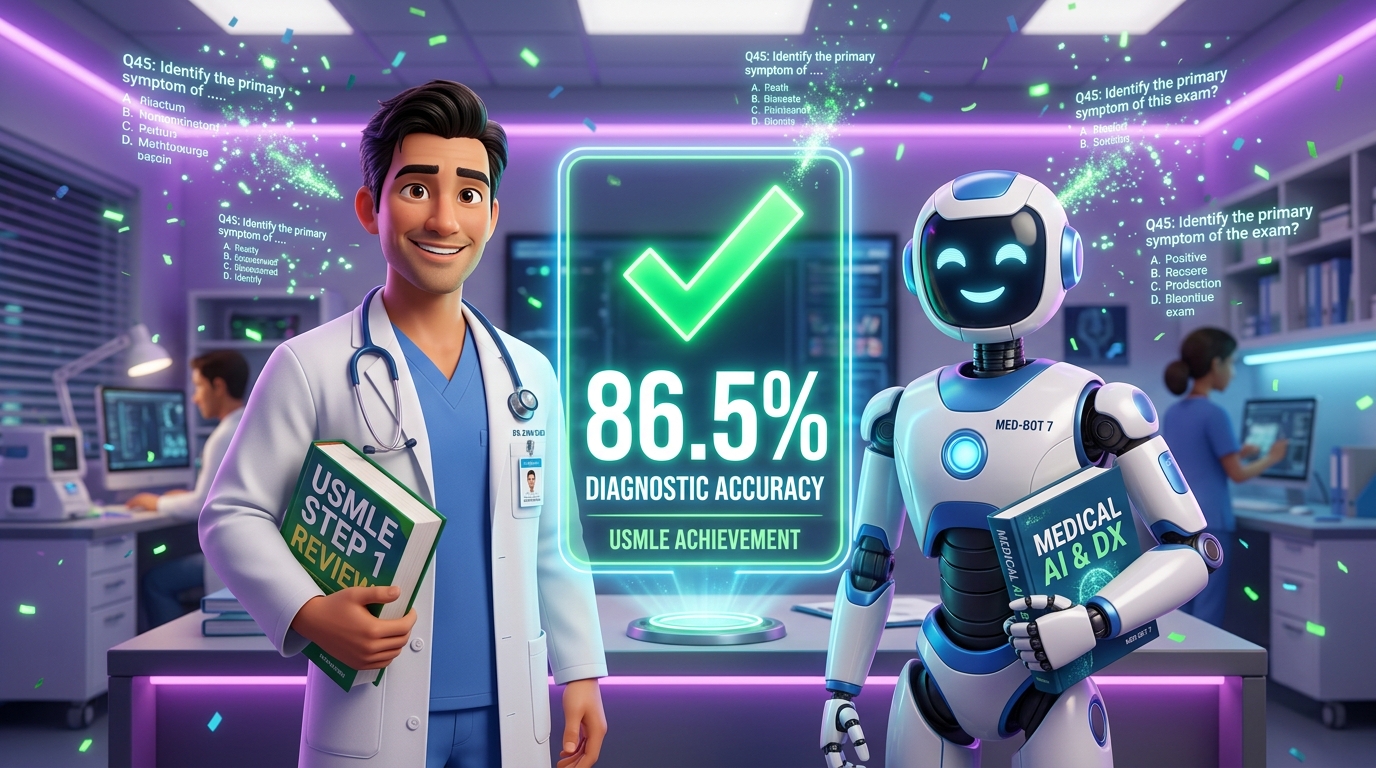
A benchmark is a controlled test: a fixed set of questions, a scoring rule, and a comparison group. On the latest generation of these tests, medical models have matched or exceeded average physician performance on knowledge-heavy multiple-choice domains, and one widely cited evaluation found the model preferred over physicians on 8 of 9 axes, including clinical reasoning style and knowledge recall. The axes where physicians still win tend to be the ones that require recognizing the limits of an answer, asking for more information, or expressing calibrated uncertainty.
What no benchmark can capture is the physical world of medicine: the examination, the emotional context, the patient's values, the team, the hospital's resources, and the irreversible consequence of being wrong. These are not gaps the model can close by getting bigger data; they are categories of information that simply do not exist on an exam. A benchmark measures how well a model answers questions that already have answers, and the clinical world is full of questions that do not.
Why Passing Exams Is Not the Same as Treating Patients
A physician who passed the boards but could not examine a patient, could not weigh competing diagnoses against a real history, or could not own a decision would not be trusted with a clinic. The license requires competence on the exam and a great deal else. The same standard should apply to models. Passing a benchmark qualifies a model as a candidate for further evaluation; it does not qualify the model to replace someone who took an oath.
There is also the question of accountability. When a patient outcome is wrong, a physician answers for it, and the system grounds that accountability in training, licensing, and supervision. A model has no body, no oath, and no career to lose. Attributing a decision to a benchmark score rather than to a person does not create accountability; it disperses it. This is why every serious deployment keeps a licensed clinician as the accountable decision-maker and treats the model's benchmark score as an input, not as an independent judgment.
Where the Scores Are Honestly Useful
Benchmark wins are most honest where the task is close to the test format: knowledge retrieval, summarizing a lab panel, explaining a medication, triaging a well-specified complaint. In those roles, a model that scores well on clinical knowledge tests can genuinely assist, and several studies show models matching or edging clinicians on structured factual questions. Using them there is not inflated; it is appropriate delegation.
The inflation happens when a model's exam score is cited to justify autonomy over open-ended clinical judgment. Reading the score carefully means separating the two: the machine that answers questions well is a powerful consultant in the loop, and the machine that answers questions well is not automatically a safe decision-maker outside the loop. The boundary is drawn by accountability and by information the machine never receives, not by IQ on a multiple-choice test.
How to Read the Next Big Claim
When the next study announces that AI beat doctors, apply three prompts before accepting the claim. First, what was tested: multiple-choice recall, or real cases with missing data and consequences? Second, on what population: curated question banks, or the messy variety of a clinic? Third, what changed: a better score on the test, or a better outcome for an actual patient?
Claims that survive those three questions are informative and rare. Claims that do not are still worth reading, because each partial result is a step toward genuinely useful capabilities. The skill is not to dismiss the benchmark, but to hold the headline to its own boundary: better at the exam is a real achievement, and it is also one thing, not everything, and not the same thing as a safer bedside.
What an Exam Score Can't See: The Clinical Encounter
A licensing exam presents a patient as a block of typed text, complete, unambiguous, and already formatted into a differential diagnosis. A real encounter is different. The patient speaks in fragments, the history contradicts itself, the chart is missing half the records, and the physical exam happens in a room with a clock and a family waiting outside. The model's bench-to-bedside gap is not a failure of effort; it is a difference in the information the two are given.
That difference is why the model scored higher on the test and why it still cannot practice. Reading a paragraph and interpreting a person are different tasks, and the skills involved, building rapport, noticing what is unsaid, weighing how a patient prefers to receive bad news, have never appeared on a multiple-choice item. The most interesting finding is not that AI passed the exam. It is that passing the exam leaves almost all of the clinical encounter unmeasured.
The Accountability Question: Who Answers for the Answer?
Every medical answer ultimately needs someone accountable for it, and that is where a benchmark score stops being the point. A physician who makes a wrong call faces consequences: a conversation with the patient, a chart review, professional standards, sometimes a license review. A model that gives a wrong answer has no body to bear the responsibility. The accountability lives with the clinician who acted on it or the institution that deployed it unchecked.
This is not a philosophical side note; it is a deployment rule. The organization that places a model in a clinical path must carry the decision rights and the liability that come with it. Regulators and malpractice frameworks increasingly expect that the human remains the accountable decision-maker, with the model as a consulted advisor. Until a model can stand in front of a patient and own a choice, the score it earned on the exam is the beginning of its qualification, not the end of the conversation.
How to Read a Headline Like a Regulator
A regulator reading an AI-beats-doctors headline asks a different set of questions than a casual reader. What population was the test drawn from, and does it resemble the one the model will face? Was the evaluation done in the controlled setting of a question bank or in the messy reality of a shift? Which group did the scoring, the model's own maker, an independent lab, or a peer-reviewed study? Each answer changes what the number earns the claim.
That kind of skepticism is transferable to any patient or clinician. Before you believe a new model is better than the last one, ask what it was tested on and who verified the test. Ask whether the error that matters in your situation, the under-recognized rare case, the overconfident answer, the failure mode common to real patients, was even measured. Headlines compress the nuance out of benchmarking; regulators exist to put the nuance back in, and you can borrow their questions without their title.

Dr. Elena Rostova, MD, PhD
Dr. Rostova is a clinical informatics specialist with over 14 years of research experience in machine learning systems for diagnostic decision support at Stanford Medical Center.
Expert Takeaway
Passing exams is a floor, not a ceiling, for clinical competence. A model that outscores physicians on a benchmark earns attention, but the clinical takeaway is unchanged: high-stakes interpretation and final medical decisions still belong to a licensed clinician who can be held accountable and who reads the whole patient, not just the test set.
QFrequently Asked Questions
Q1Did an AI actually beat doctors on a medical test?
Yes. In a widely cited 2024 evaluation, a large medical model was preferred over physicians on 8 of 9 clinical reasoning axes, including knowledge recall. Those are real, measurable wins on structured test-style questions.
Q2If AI beats doctors, why is it not practicing medicine alone?
Because the test measures answering questions, not practicing medicine. Practice involves physical examination, incomplete histories, patient values, team coordination, and personal accountability for outcomes, none of which appear on a multiple-choice benchmark.
Q3What does a benchmark score actually prove about a medical AI?
It proves the model can retrieve and reason over medical knowledge under test conditions. That qualifies it as a candidate for further evaluation in specific assistance roles, not as an independent substitute for a licensed clinician.
Q4How should I interpret the next 'AI beats doctors' headline?
Ask what was tested, on what population, and whether the score changed a real patient outcome. If the answer is a curated question bank with no clinical outcome attached, treat the result as a meaningful step, not as evidence that machines have replaced judgment.
Q5Why do doctors still prefer their own reasoning if the machine scores higher?
Because the score measures a narrow slice of the job. Physicians bring accountability, context, the physical exam, and the ability to own a decision with a patient who needs it. A benchmark says nothing about whether the answer is safe to act on, and acting on it is the actual practice of medicine.
Q6Will better benchmarks eventually close the accountability gap?
No, because accountability is not a capability that improves with data; it is a property of responsibility. A model can become more accurate and still have no one to answer for its harm. Closing the gap means finding the human who owns the model's output in real use, which no benchmark can automate.
Verified References & Literature
Capabilities of Large Language Models in Clinical Reasoning: A Direct Comparison With Human Physicians
The Lancet Digital Health, 2024
View SourceThe Limits of Benchmark Evaluations for Medical AI: What Test Scores Do and Do Not Measure
npj Digital Medicine, 2024
View SourceEvaluation Phases for Clinical AI: From Benchmarks to Bedside Outcomes
Journal of the American Medical Association, 2025
View SourceGet a structured second read in seconds
Upload lab results, describe symptoms, or ask about a diagnosis — Premedice gives you medically-grounded answers backed by 30+ clinical databases.