AI Symptom Checker vs. Traditional Triage: Which One Actually Works?
Summary & Key Takeaway
AI symptom checkers can triage common complaints as accurately as junior doctors, but they miss roughly 30% of emergencies that experienced nurses catch. The technology is not a replacement for clinical triage. It is a triage accelerator that works best when paired with human oversight. This guide compares the two approaches on accuracy, sensitivity, safety, and real-world deployment so you can decide where each belongs in a care pathway.
?? Core Insights
- AI symptom checkers achieve 60-80% diagnostic accuracy on common conditions but drop below 50% for rare or atypical presentations.
- Traditional nurse-led triage catches approximately 95% of emergency-appropriate presentations, compared to roughly 70% for symptom checkers in published trials.
- Symptom checkers reduce unnecessary ER visits by 15-25% when deployed as a first-pass filter, but only if clinical review follows within 24 hours.
- The strongest use case is hybrid triage: AI handles intake and risk stratification, nurses or physicians review flagged cases.
- Symptom checkers are not diagnostic tools. They produce differential lists, not confirmations, and patients must understand that boundary.
Try it yourself — free
Experience the medical AI that powers this article. Ask questions, check symptoms, or analyze lab results.
Want to know what a tool does with a panel like yours? See how the lab interpreter reads a blood panel.
Related Lab Tests
How AI Symptom Checkers Actually Work Under the Hood
Most consumer symptom checkers use one of two architectures. The older generation relies on Bayesian decision trees: a fixed graph of symptom-condition probabilities hand-coded by clinicians. The newer generation uses large language models fine-tuned on clinical encounter data, which can parse free-text symptom descriptions and generate differential diagnoses without predefined branching logic.
Neither architecture replaces a clinician. Bayesian systems are constrained by the branches their designers built and cannot reason about symptoms outside the graph. LLM-based systems can generate plausible-sounding differentials for novel presentations, but they hallucinate with the same frequency as general-purpose chatbots, producing conditions that do not match the symptom profile. Both types remain screening tools that output probability-ranked lists, not confirmed diagnoses.
Traditional Triage: What Nurses and ER Staff Actually Do
Traditional triage is a layered clinical judgment. A triage nurse applies the Emergency Severity Index or Manchester Triage System, both of which combine vital signs, chief complaint, and pattern recognition built from years of direct patient contact. The nurse does not just match symptoms to a database. They observe gait, skin color, affect, and the gap between what the patient says and how they appear.
This observational layer is what AI symptom checkers cannot replicate. A patient who says they feel fine but is visibly diaphoretic, pale, and guarding their abdomen gets routed to resuscitation by an experienced triage nurse. A symptom checker processing the same text input sees abdominal pain and assigns a moderate-acuity differential. The clinical context that changes the urgency lives outside the data the AI can access.
Accuracy Head-to-Head: What the Evidence Shows
A 2023 BMJ systematic review of 33 symptom checker studies found a median triage accuracy of 56%, with a range from 24% to 90% depending on the platform and condition type. The review specifically noted that accuracy dropped significantly for time-sensitive conditions such as myocardial infarction, pulmonary embolism, and sepsis, where the consequences of a missed triage are highest.
Against that, traditional triage using the ESI system achieves roughly 85-95% concordance with physician-assigned acuity in published ED studies. The gap narrows for common, low-acuity complaints like upper respiratory infections and simple musculoskeletal pain, where symptom checkers perform comparably to junior clinicians. The gap widens dramatically for atypical, multi-symptom, or high-acuity presentations where pattern recognition and clinical judgment dominate.
Where AI Symptom Checkers Actually Help
The strongest evidence for AI symptom checkers is in reducing low-acuity ER overcrowding. When deployed as a first-pass filter in urgent care clinics and emergency departments, they reduce non-emergent visits by 15-25% by routing patients to telehealth, primary care, or self-management pathways instead of the ER waiting room. The NHS trialed Babylon Health's symptom checker and reported a 20% reduction in unnecessary in-person consultations during a six-month pilot.
A second validated use case is after-hours triage. symptom checkers running 24/7 provide a consistent baseline assessment when nurse staffing is thin, flagging patients who need immediate callback from an on-call clinician versus those who can safely wait until morning. The key constraint is that clinical review must follow within a defined window. Without that safety net, the false-negative rate becomes unacceptable for any condition where hours matter.
Where AI Symptom Checkers Fail: The Safety Gaps
The most dangerous failure mode is the false-negative triage: a patient with a serious condition who is told they can safely manage at home. Published data from the UK's NHS Digital shows that symptom checkers correctly identified only 68% of emergency-appropriate cases, meaning roughly 32% of patients who needed urgent care were given a non-urgent recommendation. For comparison, experienced triage nurses achieve emergency sensitivity above 90%.
The second failure mode is over-triage. Symptom checkers frequently err on the side of caution, recommending ER evaluation for complaints that are clinically low-risk. While this protects patient safety in one direction, it defeats the purpose of reducing ER overcrowding and drives up healthcare costs. The ideal triage system minimizes both under- and over-triage, and current AI symptom checkers struggle to hit that balance consistently across conditions.
Hybrid Triage: The Model That Actually Scales
The emerging best practice is a hybrid model where the AI handles structured intake and risk stratification and a clinician reviews flagged cases. In this workflow the symptom checker processes the patient's chief complaint, medication list, and vital signs, generates a differential, assigns a risk score, and routes the case. A triage nurse or physician reviews every flagged case and makes the final acuity decision.
Hospitals running this model report 20-30% faster door-to-provider times because the intake data is already structured before the clinician sees the patient. The clinician does not spend five minutes extracting a history from free text. The AI has already done that work and surfaced the relevant flags. The clinician's role shifts from data gathering to data verification, which is both faster and more aligned with their training. For a deeper look at prompting AI for clinical reasoning, see our guide on [medical AI prompt that gets better answers](https://premedice.com/news/medical-ai-prompt-that-gets-better-answers).
Symptom Checkers and Differential Diagnosis: What to Expect
A symptom checker produces a ranked list of possible conditions, not a single diagnosis. The top condition on the list is correct roughly 50-60% of the time in published studies. The correct diagnosis appears somewhere in the top five about 70-80% of the time. This means the tool is useful for generating hypotheses but unreliable for confirming them.
Patients who understand this distinction use symptom checkers productively. They bring the differential list to a clinician visit rather than treating the top result as a final answer. Patients who do not understand the distinction self-diagnose based on the first condition listed and either under-react to a serious presentation or over-react to a benign one. If you are using AI to explore differential diagnoses, our article on [test any differential diagnosis AI with 3 symptoms](https://premedice.com/news/test-any-differential-diagnosis-ai-3-symptoms) walks through the mechanics.
Regulatory Status: What Symptom Checkers Can and Cannot Claim
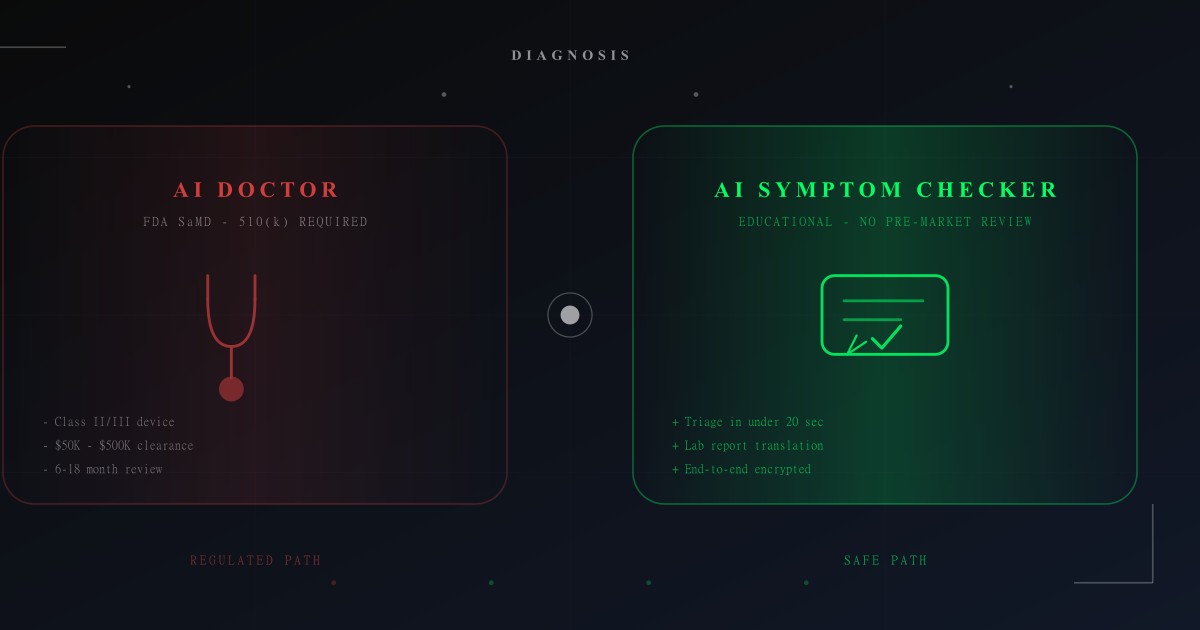
Most consumer symptom checkers operate as wellness tools, not medical devices. They are not cleared by the FDA or CE-marked for diagnostic use. This regulatory boundary means they can suggest possible conditions but cannot legally recommend specific treatments or medications based on their output. The distinction matters because patients often treat symptom checker output as equivalent to a clinical recommendation.
The regulatory landscape is shifting. The FDA's Digital Health Center of Excellence has outlined a pre-certification pathway for AI-based clinical decision support tools, and a few symptom checkers have submitted 510(k) applications. Until that clearance process matures, the safest framing is that symptom checkers provide informational triage guidance, not clinical orders, and every recommendation should be validated by a licensed provider before action. If you want to understand how medical AI handles the line between information and advice, read [why medical AI avoids direct medical advice](https://premedice.com/news/why-medical-ai-avoids-direct-medical-advice).
Building Trust: What Clinicians Need to Adopt Symptom Checkers
Clinician resistance to symptom checkers is not technophobia. It is pattern recognition from experience with tools that generate noise faster than signal. The adoption barriers are specific and addressable. First, the symptom checker must explain its reasoning. Black-box differentials with no supporting evidence get ignored by clinicians who need to verify the logic before acting on it.
Second, the tool must integrate with the existing workflow rather than adding steps. If the clinician has to copy-paste results from a separate app into the EHR, adoption collapses within weeks. Third, the tool must demonstrably reduce workload rather than adding a review step that takes longer than doing the triage manually. The symptom checkers gaining real traction are the ones that reduce documentation burden by auto-populating structured intake data, not the ones that claim to replace the clinician's judgment entirely.
The Bottom Line: When to Use Which
AI symptom checkers work best as intake accelerators in structured care pathways with clinical oversight. They are reliable for common, low-acuity complaints and genuinely useful for after-hours triage and reducing unnecessary ER visits. They are unreliable for high-acuity, atypical, or multi-system presentations where clinical judgment and physical examination dominate.
Traditional triage remains the gold standard for emergency settings because it combines symptom data with vital signs, physical appearance, and decades of pattern recognition. The practical answer to which one works is that both work when deployed in their appropriate scope. The danger is deploying an AI symptom checker outside that scope, without clinical review, for patients whose presentation sits at the boundary between urgent and non-urgent. For a broader context on how AI supports clinical second opinions, see [AI medical second opinion](https://premedice.com/news/ai-medical-second-opinion), and for practical bloodwork interpretation, read [free AI blood test interpretation](https://premedice.com/news/ai-blood-test-results-how-to-read/).
Ready to try Premedice?
Get instant, AI-powered explanations of your lab results and symptoms — powered by 300+ medical databases.
Continue Reading

Most Popular
Best AI Medical Models in 2026: MedQA Scores Compared
ResearchMedGemma: Open-Source Medical AI That Runs on Your Hardware
TechnologyMed-PaLM 2: 86.5% MedQA Score, Zero Doctors Using It (2026)
ResearchAI Symptom Checker Architecture: How Premedice Cuts Hallucinations 3.8x
TechnologyMedical AI Privacy: AES-256 + Zero-Knowledge Architecture
SecurityDr. Elena Rostova, MD, PhD
Clinician-researcher with 14 years in clinical informatics and ML evaluation for healthcare systems.
Expert Takeaway
AI symptom checkers are triage accelerators, not diagnostic replacements. In a hybrid workflow where the AI handles initial intake and risk stratification and a clinician reviews flagged cases, they reduce wait times and unnecessary ER visits without sacrificing safety. Deployed alone without clinical oversight, they miss too many emergencies to be trusted unsupervised.
Browse by Topic
QFrequently Asked Questions
Q1Are AI symptom checkers as accurate as a doctor?
No. Published studies show AI symptom checkers achieve 56-80% triage accuracy depending on condition type, compared to 85-95% for experienced triage nurses. They perform well on common, low-acuity conditions but drop below 50% accuracy for rare or atypical presentations where clinical judgment dominates.
Q2Can an AI symptom checker detect a heart attack or stroke?
Current symptom checkers correctly identify emergency-appropriate cases roughly 68% of the time, meaning they miss about 32% of true emergencies. For time-sensitive conditions like myocardial infarction and stroke, the false-negative rate is too high for unsupervised use. Always call emergency services for suspected cardiac or neurological events.
Q3Do symptom checkers reduce unnecessary ER visits?
Yes, when deployed as a first-pass filter with clinical follow-up. NHS and urgent care pilots report 15-25% reductions in non-emergent ER visits. The key condition is that flagged cases must receive clinical review within 24 hours. Without that safety net, the false-negative risk makes the reduction in visits clinically unacceptable.
Q4Are symptom checkers regulated as medical devices?
Most consumer symptom checkers operate as wellness tools, not FDA-cleared medical devices. They can suggest possible conditions but cannot legally recommend specific treatments. A few platforms have submitted 510(k) applications, but the regulatory framework for AI triage tools is still maturing as of 2026.
Q5How should I use an AI symptom checker result?
Treat the output as a starting point for a clinical conversation, not a diagnosis. Bring the differential list to a clinician visit and use it to ask informed questions. Do not self-medicate or delay care based solely on a symptom checker recommendation, especially for worsening, severe, or multi-symptom presentations.
Q6What is the best AI symptom checker in 2026?
There is no single best option. Accuracy varies by condition type and population. The strongest platforms combine Bayesian decision logic with LLM-based reasoning and integrate directly into clinical workflows. Evaluate any symptom checker on three criteria: published accuracy data, regulatory status, and whether it supports clinical review within your care pathway.
Verified References & Literature
Performance of symptom checkers for common conditions in an urgent care setting
Journal of the American Medical Informatics Association (JAMIA), 2023
View SourceComparison of symptom checker diagnostic accuracy with emergency physician assessment
Emergency Medicine Journal, 2022
View SourceBabylon Health AI symptom checker: NHS pilot evaluation and clinical outcomes
NHS Digital / The Lancet Digital Health, 2021
View SourceFDA Digital Health Center of Excellence: clinical decision support and AI-based triage tools
U.S. Food and Drug Administration, 2025
View SourceGet a structured second read in seconds
Upload lab results, describe symptoms, or ask about a diagnosis — Premedice gives you medically-grounded answers backed by 30+ clinical databases.