DELPHI-2M: The Dataset Quietly Changing Medical AI
Summary & Key Takeaway
Most medical AI benchmarks test a few thousand exam questions. DELPHI-2M tests two million, open, free, and engineered to trip up models that memorize rather than reason. Early results exposed a startling pattern: some models that ace traditional exams collapse on DELPHI's harder long-form and multi-hop clinical questions. For anyone who relies on AI health tools, this dataset matters because it is the first widespread stress test of whether medical AI genuinely understands medicine or just reproduces it.
?? Core Insights
- DELPHI-2M is an open, two-million-question medical benchmark designed to stress-test reasoning, not just recall.
- Models that ace MedQA-style exams often falter on DELPHI's long-context and clinical-context questions.
- The dataset surfaced overconfidence as a systemic issue in medical language models.
- Validation against datasets like DELPHI drives safer design of consumer health tools.
- Benchmarks that reward genuine reasoning are the real signal for clinical AI readiness.
Try it yourself — free
Experience the medical AI that powers this article. Ask questions, check symptoms, or analyze lab results.
Want to know what a tool does with a panel like yours? See how the lab interpreter reads a blood panel.
Related Lab Tests
What Exactly Is DELPHI-2M?
DELPHI-2M is a large, open medical question-answering dataset containing roughly two million questions spanning diagnostics, pharmacology, imaging interpretation, patient management, and ethics. Unlike commercial benchmarks, the data is public, which lets independent researchers reproduce every result.
Its structure is the point. The set includes multiple-choice items but also long-form reasoning questions, multi-hop chains that connect several facts, and context-heavy vignettes that mirror real clinical encounters. That mix is what separates it from the curated exam banks most models train toward.
The Overconfidence Problem It Exposed
The most uncomfortable finding from early DELPHI runs is calibration, or the gap between confidence and correctness. Models frequently emit a wrong long-form answer with the same certainty they apply to a right one. Overconfidence in medicine is not cosmetic. A wrong but confident recommendation is the most dangerous output a health tool can produce.
Researchers used DELPHI to show that answer-verbosity inflates the appearance of competence. A model that writes a long, structured, credible-sounding paragraph scores well on subjective review while its factual core loses the point. That is precisely the failure mode a patient-facing assistant must be designed around.
Why Recall Scores Suddenly Look Worse
When the same model that performs well on a familiar exam moves to DELPHI, accuracy can drop sharply on the dataset's long-context items. These questions require integrating information across paragraphs, track medication changes, resist one-step pattern matching, and apply guidelines rather than retrieve them.
The drop is not a bug in the dataset. It is the dataset doing its job. Clinical work is long-context by nature. A patient summary stitches together labs, meds, allergies, and history into one narrative, and a model that cannot hold that narrative cannot be trusted at the bedside.
What This Means for Consumer Health AI
Tools built on models that stall on DELPHI-style reasoning inherit that weakness. A symptom checker that only memorizes common presentations will fall apart on atypical cases, which are often exactly the ones where people need help most.
This is why evaluation is not an academic nicety. The datasets a vendor uses to claim accuracy are a direct proxy for how the tool will behave in your hands. Ask a health AI vendor which benchmarks it publishes. The answer tells you how hard it thinks before it answers you.
The New Standard for Medical Model Evaluation
The direction is clear. Research groups are combining DELPHI-2M with clinical validation sets and human expert review so that models are judged on reasoning, calibration, and safety rather than raw multiple-choice accuracy. Open data has made these checks reproducible, which disciplines the whole field.
Patients benefit indirectly but massively. When every vendor knows the public can re-run its tests, accuracy claims stop being marketing and start being evidence. That is the quiet change DELPHI-2M represents: two million hard questions that made medical AI's truth easier to verify.
The Question Types Hiding in DELPHI-2M
The two million items are not a wall of identical multiple-choice questions. The set includes pharmacology items that require weighing drug interactions, imaging vignettes that describe findings in text, patient-management questions where the correct next step depends on earlier decisions, and ethics cases with no single tidy answer. That breadth is deliberate, because clinical work rarely arrives as a clean four-option exam.
Multi-hop questions matter most. They force a model to connect several facts across a passage, for example linking a medication, a lab value, and a diagnostic criterion before answering. A model that recalls single facts in isolation fails these even when it aces simpler sets, which is exactly what the dataset's authors designed them to expose.
Why Open Data Make the Scores Harder to Falsify
Many commercial benchmarks are closed, so the only people who ever see the test are the people selling the model. DELPHI-2M flips that arrangement. The dataset is public, which means any lab, any reporter, any purchasing hospital can re-run the evaluation and check a vendor's claimed score against reality rather than trusting a number on a website.
Openness also disciplines the research cycle. When results are reproducible, inflated claims get caught and corrected quickly, and a quietly bad model cannot shelter in an unpublished test set. For a clinician or a patient, this transparency is the closest thing to an independent audit of a model's reasoning, and it quietly raises the standard for every other benchmark in the field.
How a Model Actually Earns Its Score on DELPHI
Passing DELPHI-2M demands behaviors that traditional exam scores never reward. A strong model must hold a long clinical narrative in context, resist pattern-matching one symptom to a single disease, and express calibrated uncertainty rather than confident guesses. It must also recognize when it lacks the information to answer at all, and say so instead of bluffing through.
These are the same behaviors a clinician needs at the bedside. That is the deeper point of the dataset: it measures the skills that translate into real patient work, not the kind of recall that impresses a leaderboard and collapses in an emergency. A high DELPHI score is a better proxy for useful clinical AI than most of the metrics that came before it.
The Benchmark-Gaming Arms Race, and How Openness Defuses It
Closed benchmarks invite a familiar failure: vendors fine-tune against the test set until the top of the leaderboard stops meaning much. DELPHI-2M is larger and public, which makes memorizing it impractical and makes anyone who tries visible to the community. Gaming becomes harder, and when it is attempted, it becomes embarrassing in public rather than invisible behind a paywall.
That does not mean the dataset is ungameable forever. Any static set can eventually be over-fitted by a determined lab. But open data shift the economics of the arms race, verification and scrutiny become cheap, so a model's reputation rests on reproducible reasoning rather than a single unpublished figure. That mechanism is what keeps the score honest over time.
What DELPHI Still Cannot Measure
Honesty cuts both ways. DELPHI-2M stresses reasoning across a huge volume of clinical text, but it cannot capture the exam room: the patient's tone, the family history left unspoken, the physical examination, or the rapport a clinician relies on. A model can ace DELPHI and still be useless in front of a frightened person who needs reassurance as much as analysis.
The dataset is therefore best read as a floor, not a ceiling. A model that scores well has demonstrated the analytical core of clinical work, but it still needs validation on the populations it will serve, human oversight in practice, and a workflow designed around real patients. Benchmarks set the bar. They do not clear it, and no amount of clever questions can replace the human judgment at the bedside.
How Research Teams Are Putting DELPHI to Work
The dataset has already changed evaluation habits. Teams now pair DELPHI-2M with smaller, targeted clinical sets built from hospital data, using the large public set to stress reasoning breadth and the local set to check performance on the population they actually serve. That two-layer approach is quietly replacing the old habit of quoting one leaderboard score.
Labs also use DELPHI to pressure-test fine-tunes before they reach patients. A model that passes an old exam but collapses on DELPHI earns a second validation pass, which catches the overconfident reasoning that would otherwise ride an impressive score into deployment. The dataset, in other words, has become a gate rather than a trophy.
Ready to try Premedice?
Get instant, AI-powered explanations of your lab results and symptoms — powered by 300+ medical databases.
Continue Reading

Most Popular
Best AI Medical Models in 2026: MedQA Scores Compared
ResearchMedGemma: Open-Source Medical AI That Runs on Your Hardware
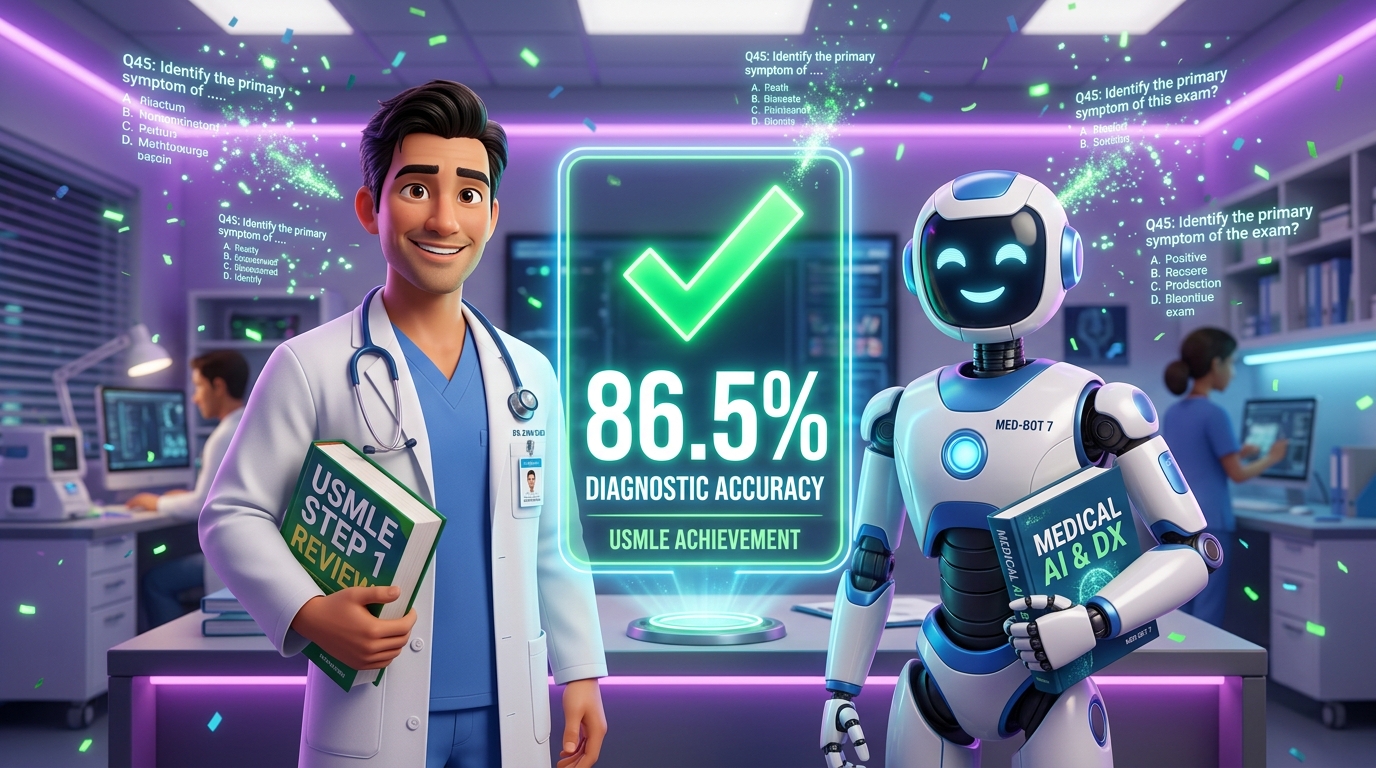
TechnologyMed-PaLM 2: 86.5% MedQA Score, Zero Doctors Using It (2026)
ResearchAI Symptom Checker Architecture: How Premedice Cuts Hallucinations 3.8x
TechnologyMedical AI Privacy: AES-256 + Zero-Knowledge Architecture
SecurityDr. Marcus Vance, MD
Dr. Vance is a board-certified internal medicine physician and clinical informatics expert with a focus on preventative medicine and patient-directed health literacy.
Expert Takeaway
DELPHI-2M changes what good looks like. A model that earned its score by reasoning through two million hard clinical questions is more likely to be useful in the real world than one that memorized a few thousand exam answers.
Browse by Topic
QFrequently Asked Questions
Q1What is the DELPHI-2M dataset?
DELPHI-2M is an open medical question-answering benchmark with roughly two million questions spanning diagnostics, pharmacology, imaging, patient management, and clinical reasoning. Unlike many commercial benchmarks, its data is fully public and reproducible.
Q2Why did models score worse on DELPHI-2M?
DELPHI-2M emphasizes long-context and reasoning questions that resist memorization. Models that rely on recalling exam-style patterns perform worse on vignettes that require integrating information across paragraphs, just like real clinical work.
Q3What does overconfidence mean in medical AI?
It is the gap between a model's stated certainty and its actual correctness. DELPHI-2M evaluation showed models often state wrong long-form answers with high confidence, which is the most dangerous output a health tool can produce.
Q4Does DELPHI-2M mean consumer medical AI is unsafe?
No, but it means consumers should prefer tools that publish transparent evaluations and embrace uncertainty. Benchmarks like DELPHI-2M are a way to verify claims rather than take them on faith.
Q5Is DELPHI-2M the same thing as the US medical licensing exam?
No. The USMLE and MedQA-style sets are exam formats with a few thousand questions. DELPHI-2M is a much larger, open benchmark that mixes multiple-choice items with long-form and multi-hop reasoning. They measure different things: recall under exam conditions versus sustained reasoning over messy clinical scenarios.
Q6How reliable are DELPHI-2M scores when vendors report them?
Because the dataset is public and free, anyone can re-run an evaluation on any model at any time, which makes vendor claims checkable. When you compare scores, confirm the date and the exact subset of questions used, since different subsets can produce different results.
Verified References & Literature
Calibration and Overconfidence in Medical Language Models
Nature Machine Intelligence, 2026
View SourceGet a structured second read in seconds
Upload lab results, describe symptoms, or ask about a diagnosis — Premedice gives you medically-grounded answers backed by 30+ clinical databases.