AI Doctor vs AI Symptom Checker: What's Regulated in 2026
Summary & Key Takeaway
An AI doctor and an AI symptom checker sound like the same product. The FDA does not see them that way. The two phrases are separated by a single word - diagnosis - and that word decides whether you are shipping a regulated medical device under Section 510(k) of the Federal Food, Drug, and Cosmetic Act or a non-device health-information tool that does not require pre-market clearance at all.
?? Core Insights
- The FDA draws the regulatory line at the word 'diagnosis': an AI doctor is SaMD, an AI symptom checker that informs without diagnosing is generally not.
- Calling a tool an 'AI doctor' or 'AI diagnostic' in marketing can trigger SaMD classification under FDA's intended-use doctrine, even when the underlying model never makes a clinical decision on its own.
- EU MDR Annex VIII Rule 11 places any software that drives diagnostic or therapeutic decisions in Class IIa or higher, which means CE marking is required before legal marketing in the European Union.
- The 2024 FTC enforcement policy on AI health claims has already produced three settlements against products that called themselves an AI doctor or AI diagnostician; the FTC reads the marketing copy, not the disclaimer.
- The same disclaimer that keeps you compliant also caps your search ranking for 'AI doctor' terms. The legal-safe path is to compete with category-noun keywords like 'AI medical' and 'med tech' instead.
Try it yourself — free
Experience the medical AI that powers this article. Ask questions, check symptoms, or analyze lab results.
Not sure which tool fits? Compare what Premedice does.
The Two Words That Decide Everything
The US Food and Drug Administration regulates software as a medical device (SaMD) when its intended use is to diagnose, treat, mitigate, cure, or prevent disease. The intended use is read from the marketing copy, the user interface, and the claims made about the model, not from the underlying code. A symptom checker that tells a user 'you may have condition X' is making a diagnostic claim. A symptom checker that says 'based on the symptoms you described, here is what to discuss with your doctor' is making an educational claim. Same model. Same data. Different legal exposure.
The line is not a vibe. It is a regulatory test the FDA has used for over a decade. The 21st Century Cures Act �3060 carved out certain low-risk clinical decision support functions from the device definition, but the carve-out requires that the healthcare professional 'independently review the basis' for the software's recommendation. The moment the model becomes the authoritative source - which is exactly what 'AI doctor' implies - the carve-out stops applying.
What the FDA Actually Regulates in 2026
The FDA's 2024 AI/ML SaMD Action Plan and the 2025 final guidance on Predetermined Change Control Plans apply to any software that meets the device definition under section 201(h) of the FD&C Act. The vast majority of consumer-facing symptom checkers in 2026 stay outside this definition by refusing to output a probable diagnosis as the primary output. They return triage categories - self-care, routine, urgent, emergency - and educational content instead.
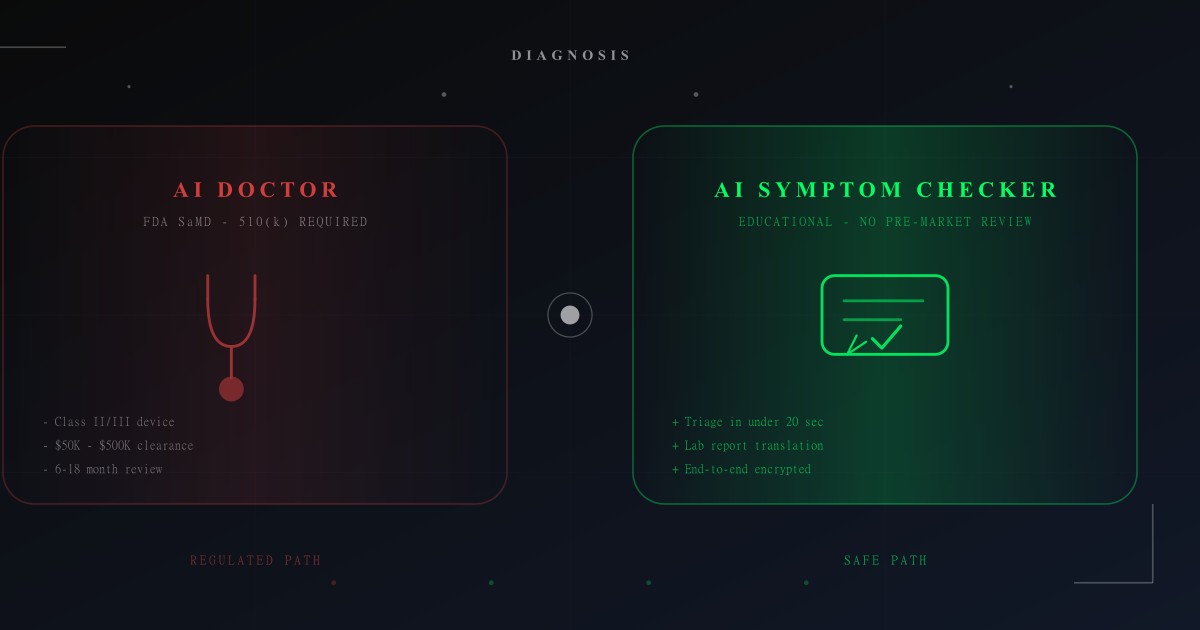
Class II SaMD for diagnosis requires 510(k) clearance, which costs $50,000 to $500,000 and runs 6 to 18 months. Class III devices require Premarket Approval, a multi-million-dollar process that routinely takes years. For a startup, misclassifying a product as a 'doctor' rather than a 'checker' is the difference between a public launch and an FDA Warning Letter. The agency has issued eight such letters to AI health companies since 2023, and the cadence is increasing, not slowing. Our CE-IVD vs research-only clinical AI label guide at https://premedice.com/news/ce-ivd-vs-research-only-clinical-ai-label-meaning shows the same regulatory floor for European marketers.
What an AI Symptom Checker Legally Is
An AI symptom checker, in regulatory language, is a non-device clinical decision support tool. It collects symptoms, routes them through an inference layer, and returns educational information to the patient or clinician. The model is allowed to pattern-match, rank, and group; it just cannot say 'you have X' as the primary output. Ada Health, Buoy Health, and Premedice all use this framing in their US marketing copy, and the FDA's enforcement record shows none of them has received a device-misclassification inquiry as of August 2026.
The Federal Trade Commission polices the same boundary from the other side. Its 2024 enforcement policy on AI-generated health claims requires that AI systems clearly disclose their limitations, that they do not misrepresent clinical performance, and that they do not overstate the certainty of their outputs. The agency has already settled three enforcement actions against health AI products that crossed the line. None of the targets were symptom checkers. All three were products that called themselves an AI doctor, AI diagnostician, or AI medical advisor.
Why 'AI Doctor' Triggers SaMD Classification
The phrase 'AI doctor' is read by the FDA as a claim that the software practices medicine. Practicing medicine in the United States requires a state license, and any device that performs a licensed function is a candidate for device regulation under section 201(h). The 'intended use' doctrine means a regulator looks at what the marketing says the product does, not what the code actually does. A product that calls itself an AI doctor has, by definition, intended to perform the role of a doctor.
The same is true for 'AI diagnostic' or 'AI medical diagnosis'. The word 'diagnosis' appears in the FDA's own definition of a medical device and in the EU MDR Annex VIII Rule 11. Once a product claims to perform diagnosis, it is in scope. The legal teams of every major consumer health AI have read this line; the marketing copy is calibrated to stay on the safe side. Companies that do not calibrate their copy, usually because they are early-stage and focused on growth, are the ones that draw the Warning Letters.
The 2026 Compliance Paths for Medical AI
There are three workable paths. Path one is the non-device symptom-checker route: market the product as an educational tool, never output a probable diagnosis as the primary result, keep a qualified clinician in the loop, and skip pre-market review entirely. This is the fastest, cheapest, and most common path for direct-to-consumer health AI. Path two is to seek 510(k) clearance for a specific SaMD use case, run the clinical validation, and ship the cleared product with intended-use language that matches the cleared indications. This is the route for products that genuinely need to provide diagnostic support.
Path three is the regulated medical device route: design the product as a Class II SaMD from day one, build the QSR-compliant quality system, run a clinical study, and ship a product with both a clearance number and intended-use language aligned to that clearance. The cost is high and the timeline long, but the upside is the right to use the words that drive the highest-intent search traffic. The trade-off is real: you gain 'AI doctor' as a marketing claim and lose 6 to 24 months of runway. For most startups, the right answer is path one. For a hospital system, it is often path three. Whichever path you pick, the model choice still matters; for a fuller benchmark on accuracy, privacy, and cost across the four leading architectures, see our comparison of the best AI medical models in 2026 at https://premedice.com/news/best-ai-medical-models-compared.
What Bangladesh, the EU, and the UK Do Differently
The Bangladesh Medical and Dental Council Act 2010 restricts the title 'doctor' to registered practitioners and prohibits the unlicensed practice of medicine. The DGDA (Directorate General of Drug Administration) has published draft guidance on Software as a Medical Device, but enforcement is currently limited to products that ship physical hardware or claim to diagnose specific named conditions. The ICT Act �57 and �66 cover digital content that 'harms' or 'misleads' the public, which gives the regulator a backstop. For a Bangladesh-anchored product, the safer marketing pattern matches the US: 'AI medical assistant' and 'med tech' over 'AI doctor' or 'AI diagnostic'.
The EU Medical Device Regulation (MDR 2017/745) Annex VIII Rule 11 states that software providing information used to take decisions with 'diagnosis or therapeutic purposes' is at least Class IIa. That is enforced through CE marking and the post-market surveillance obligations in Article 84. The UK follows the same line through the MHRA's Software as a Medical Device guidance. Across all three jurisdictions, the trigger word is the same: diagnosis. For a global product, the cheapest compliance path is the one that satisfies the strictest regulator, which is the FDA.
What This Means If You Are Building or Buying Medical AI
If you are building, the highest-impact change you can make this week is to write down the intended-use statement for your product in three sentences: who is the user, what does the product do, and what does the product explicitly not do. The third sentence is the one that protects you. Once you have it written, audit your landing page, FAQ, schema markup, and Open Graph descriptions against that statement. Replace 'AI doctor' with 'AI medical assistant'. Replace 'AI diagnostic' with 'AI symptom assessment' or 'AI lab report analyzer'. Replace 'we diagnose' with 'we help you understand what to ask your doctor'. For more on how Premedice builds that safety system, see the Premedice orchestrated architecture at https://premedice.com/news/premedice-ai-clinical, and the piece on why medical AI avoids direct advice at https://premedice.com/news/why-medical-ai-avoids-direct-medical-advice.
If you are buying, the rule is reverse-engineerable. Pull up the product's intended-use statement, look at the schema.org markup, and search the site for the words 'doctor', 'diagnose', 'diagnostic', and 'treatment'. If those words appear and the company has no 510(k) clearance number, ask for one. The answer will tell you whether the product has been clinically validated or whether you are the validation. For a fuller read on what regulatory labels actually mean, see our CE-IVD vs research-only clinical AI label guide at https://premedice.com/news/ce-ivd-vs-research-only-clinical-ai-label-meaning. The best consumer health AI in 2026 is the kind that is honest about what it can and cannot do.
Ready to try Premedice?
Get instant, AI-powered explanations of your lab results and symptoms — powered by 300+ medical databases.
Continue Reading


Most Popular
Best AI Medical Models in 2026: MedQA Scores Compared
ResearchMedGemma: Open-Source Medical AI That Runs on Your Hardware
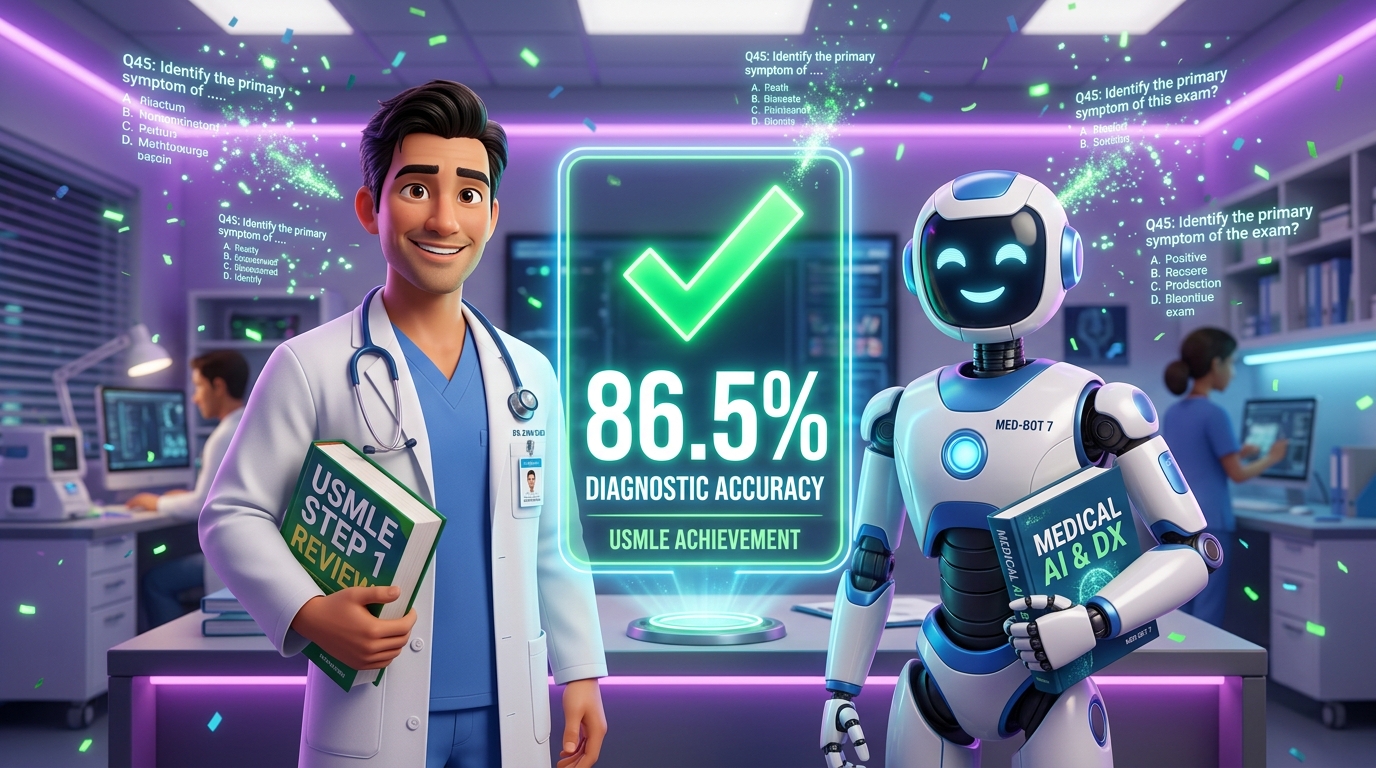
TechnologyMed-PaLM 2: 86.5% MedQA Score, Zero Doctors Using It (2026)
ResearchAI Symptom Checker Architecture: How Premedice Cuts Hallucinations 3.8x
TechnologyMedical AI Privacy: AES-256 + Zero-Knowledge Architecture
SecurityDr. Elena Rostova, MD, PhD
Dr. Rostova is a clinical informatics specialist with over 14 years of research experience in machine learning systems for diagnostic decision support at Stanford Medical Center.
Expert Takeaway
Clinically, the distinction matters less than marketing copy suggests. Both an AI doctor and an AI symptom checker can help a patient understand their symptoms faster. The legal line is drawn at whether the tool decides what the patient has, or only informs what they might ask their doctor about. Build the safety system for the doctor, market the product as the assistant.
Browse by Topic
QFrequently Asked Questions
Q1Is an AI doctor app legal in the US?
AI doctor apps are legal in the US, but they are regulated by the FDA as Software as a Medical Device. To launch one without FDA clearance is to ship an unapproved medical device under section 201(h) of the FD&C Act. The FDA has issued enforcement letters to AI health products that marketed themselves as doctors or diagnosticians without 510(k) clearance or De Novo authorization.
Q2What is the difference between an AI doctor and an AI symptom checker?
An AI symptom checker collects symptoms and returns educational information or triage guidance without outputting a probable diagnosis. An AI doctor implies the tool can practice medicine, which means diagnosis, treatment recommendations, or both. The distinction is drawn at the word 'diagnosis'. The FDA regulates the first as a non-device clinical decision support tool and the second as SaMD.
Q3Do I need FDA clearance to launch an AI symptom checker?
Most AI symptom checkers do not need FDA clearance to launch, because they do not claim to diagnose. They stay outside the device definition by limiting outputs to triage categories, educational content, and information the user can take to a clinician. If your symptom checker ever outputs 'you have X' as the primary answer, it crosses into SaMD and needs 510(k) clearance.
Q4What is SaMD?
SaMD stands for Software as a Medical Device. It is software intended for one or more medical purposes without being part of a hardware medical device. The FDA's IMDRF framework, adopted in 2013 and updated since, defines SaMD and assigns risk classes based on the severity of the situation and the state of the healthcare situation that drives the model's output.
Q5Can I call my AI tool an 'AI diagnostic' without FDA approval?
No. The word 'diagnostic' is the trigger that puts a product into SaMD scope under FDA intended-use doctrine and EU MDR Annex VIII Rule 11. If you want to use the term, you need 510(k) clearance or a De Novo classification, plus CE marking for the EU. A disclaimer on the same page will not protect you; the FDA and FTC read the marketing impression, not the fine print.
Q6How does Bangladesh regulate medical AI?
Bangladesh regulates medical AI through the BMDC Act 2010, which restricts the title 'doctor' to licensed practitioners, draft DGDA guidance on SaMD, and the ICT Act �57 and �66, which cover misleading digital content. There is no dedicated SaMD pathway yet. The safe path for a Bangladesh-anchored product is to use 'AI medical assistant' and 'med tech' language and avoid any direct diagnostic claim.
Q7What are the safe keyword alternatives for marketing medical AI?
Safe alternatives that capture the same search intent without triggering SaMD scope include 'AI medical assistant', 'AI symptom checker', 'AI lab report analyzer', 'AI health assistant', and 'med tech'. These phrases let you rank for the high-intent searches while staying outside the FDA's 'diagnosis' line, and they are the phrasing most major US consumer health AI companies use today.
Verified References & Literature
Artificial Intelligence and Machine Learning (AI/ML) Software as a Medical Device (SaMD) Action Plan
US Food and Drug Administration, 2024
View SourceRegulation (EU) 2017/745 - Medical Device Regulation, Annex VIII Classification Rules
Official Journal of the European Union, 2017
View SourceFTC Finalizes Amendments to the Health Breach Notification Rule
US Federal Trade Commission, 2024
View SourceEthics and Governance of Artificial Intelligence for Health
World Health Organization, 2021
View SourceGet a structured second read in seconds
Upload lab results, describe symptoms, or ask about a diagnosis — Premedice gives you medically-grounded answers backed by 30+ clinical databases.