The Hidden Medical AI Models Big Tech Won't Advertise
Summary & Key Takeaway
The models in the headlines, MedGemma and Med-PaLM 2, are the visible tip of a much larger iceberg. Beneath them sit specialized architectures like MedImageInsight for embeddings, MedSigLIP for medical vision-language pairing, ii-Medical-8B for instruction-tuned clinical dialogue, and XReactBase for interpretable reasoning. None of them gets a press release. Together they run much of the medical AI quietly embedded in imaging departments and research pipelines today.
?? Core Insights
- MedImageInsight generates strong medical image embeddings that power retrieval and similarity without heavy fine-tuning.
- MedSigLIP pairs medical images with clinical text, enabling zero-shot classification and image-to-report workflows.
- ii-Medical-8B brings instruction-following to a compact 8B size, practical for clinics that cannot run bigger models.
- XReactBase emphasizes interpretable, step-by-step clinical reasoning over black-box prediction.
- Specialized models trade marketing glamour for reliability, which is exactly why medicine should trust them.
Try it yourself — free
Experience the medical AI that powers this article. Ask questions, check symptoms, or analyze lab results.
Not sure which tool fits? Compare what Premedice does.
MedImageInsight: The Embedding Engine for Medical Images
MedImageInsight is a Microsoft research model built to convert medical images into dense numerical vectors, or embeddings, that capture similarity. This makes it possible to search a pathology archive by visual similarity, cluster scans, and power retrieval-augmented workflows without retraining a large model for every new task.
The practical value is dramatic. Instead of fine-tuning a giant vision model for each new imaging question, a team can compute embeddings once and reuse them across classification, retrieval, and deduplication. That is why embeddings increasingly appear as the quiet foundation under radiology workbenches.
MedSigLIP: Connecting the Image to the Words
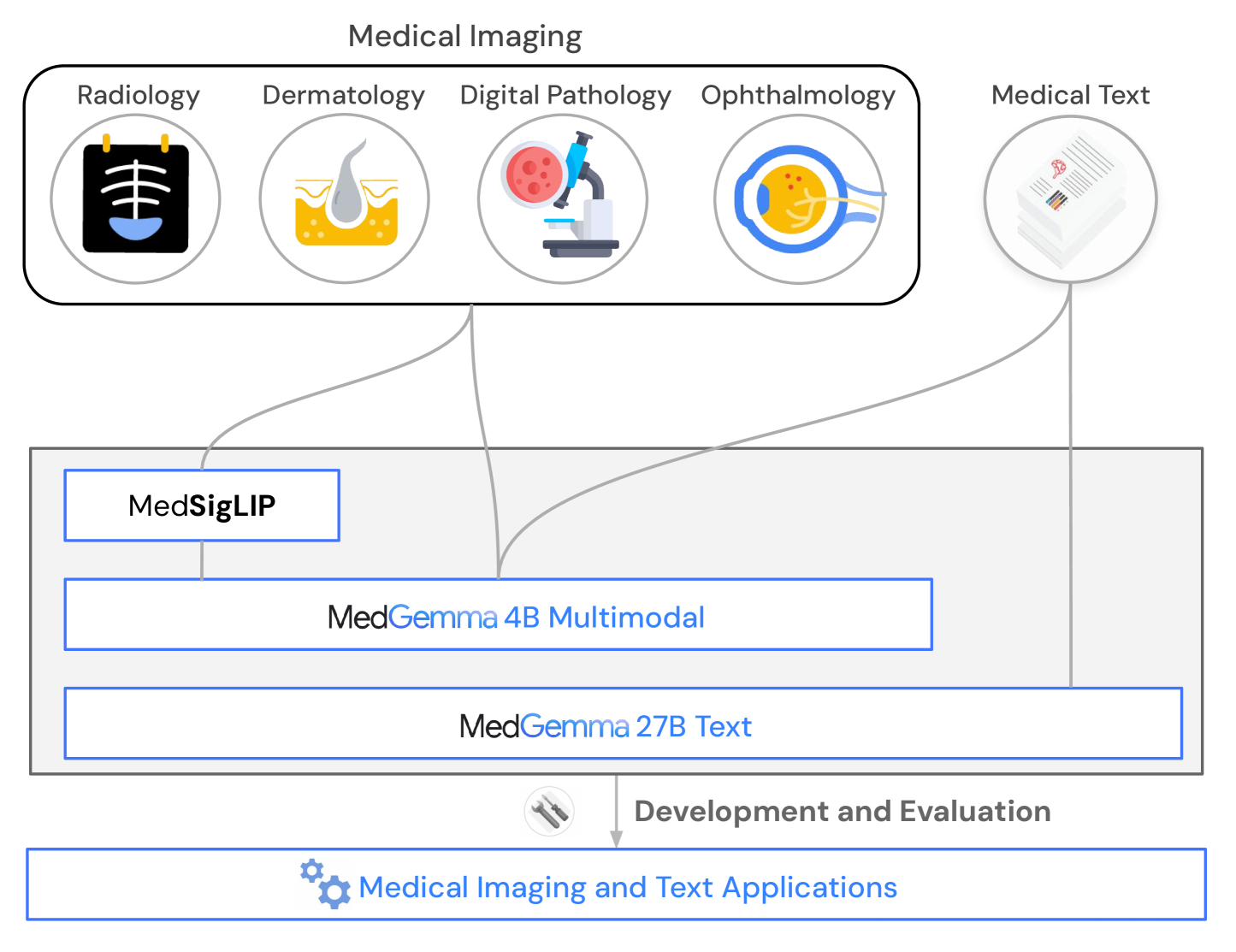
MedSigLIP adapts the SigLIP vision-language architecture to clinical data, pairing chest X-rays and histology slides with the text that describes them. That pairing powers capabilities like zero-shot disease classification, where the model can identify a condition it was never explicitly asked to find, and image-to-report drafting.
The shift matters because radiology workflows are text-heavy. A model that can correctly associate a scan with the right finding description does more usable work than a classifier stuck on a fixed label set. MedSigLIP is the style of model MedGemma's own multimodal stack builds from.
ii-Medical-8B: Instruction-Following at a Practical Size
ii-Medical-8B is a compact instruction-tuned medical model built to answer clinical questions in controllable formats. Its 8B scale is deliberate: it runs on modest infrastructure, making high-quality clinical dialogue feasible for small hospitals and resource-limited settings.
Instruction tuning is the key detail. The model is trained to obey structured prompts, output clinical summaries, and stay in domain. That makes it a workhorse for triage scripts and note-style generation where a sprawling general model would be overkill and over-costly.
XReactBase: Reasoning You Can Actually Inspect
XReactBase takes a different lane from raw prediction. It structures outputs as interpretable reasoning steps, letting a clinician see how an answer was assembled rather than receiving a confident finish. In regulatory terms, inspectability is close to a requirement; in practice it is trust.
The pattern is spreading. Regulators and clinicians alike are asking not just what a model concluded but why. Models that expose their chain of reasoning are easier to audit, easier to debug, and much easier to defend in front of a medical review board.
Why the Quiet Models Deserve Your Attention
Marketing focuses on the largest, most fluent models. Production medicine increasingly relies on the specialists. Embedding engines, vision-language pairings, compact instruction followers, and interpretable reasoners each solve one niche well, and their failures are narrower than a generalist's.
The takeaway for anyone evaluating clinical AI is to look past the fame. Ask a vendor which specialized components sit under its general interface. The architectures that never headline are often the ones doing the real clinical work, and their quality predicts the safety of what you experience as one polished feature.
How Specialized Models Chain Together in a Real Pipeline
In practice these models rarely run alone. A clinical deployment chains them: MedImageInsight computes embeddings so the system can pull similar prior scans out of an archive, MedSigLIP pairs the current image with the right clinical description, and a compact instruction-tuned model turns the matched findings into a draft note. Each stage hands structured output to the next, and the assembly behaves like a small team rather than one giant brain.
The payoff is that every step stays narrow enough to verify. The embedding search either returns the right class of prior scan or it does not. The reasoner either produces readable reasoning steps or it stalls. When something fails, the team can see which link broke instead of debugging one monolithic model that does everything opaquely. That inspectability is the quiet advantage nobody puts on a slide.
Hardware and Cost Realities of Running the Specialists
Cost is where these models win quietly. Embedding engines like MedImageInsight are light enough to run on a workstation GPU, and computing embeddings once lets a team reuse them across classification, retrieval, and duplicate detection without paying for heavy inference on every task. An 8B instruction-tuned model fits comfortably on a single modest server, a very different budget line from serving a giant generalist.
Compare that with fine-tuning and hosting a multi-hundred-billion-parameter model for one department. The specialists keep infrastructure predictable, and their narrow scope means fewer surprises in latency, licensing, and failure modes. For a small hospital or a research lab, more than anyone else, that predictable bill is often the difference between deploying this quarter and deferring to next year.
The Myth That Only the Biggest Model Is the Best
A common assumption holds that a larger, more famous model is automatically a better medical model. That logic ignores how clinical work actually fails. A compact model trained on one narrow job frequently beats a far bigger generalist at that same job, because the specialist was optimized for the failure modes that matter there, not for being impressive in conversation.
Radiology is a clear example. A system that retrieves the right prior scans, matches them to correct findings language, and emits an interpretable note can outperform a giant black-box model that simply generates a plausible paragraph. Size buys breadth; scope buys reliability. In patient care, reliability is the scarcer resource, which is why the specialists keep winning the jobs they were built for.
What a Vendor's Specialist Stack Tells You About Safety
When you evaluate a clinical AI product, ask what sits underneath the interface. A vendor that names its embedding model, its vision-language component, and its reasoning layer is describing an architecture a reviewer can actually audit. A vendor that only names one large model is often hiding a simpler, riskier deployment behind the brand name.
The pattern also predicts behavior. Specialist stacks tend to have narrower, better-documented failure modes, with each component tested against its own dataset and scope. Monolithic stacks concentrate the risk in a single opaque system, where a small change can ripple unpredictably across everything. You cannot fix what you cannot inspect, so inspectability stops being a luxury and starts being the safety feature.
Who Actually Benefits From These Quiet Models
The clearest beneficiaries are clinical teams short on time and resources. A pathologist reviewing whole-slide images benefits from an embedding search that surfaces similar prior cases in seconds. A research group scanning thousands of studies benefits from a vision-language model that drafts consistent descriptions, and a department using an instruction-tuned model gets structured draft notes instead of raw text.
Patients benefit indirectly but materially. Faster retrieval means fewer delayed reads. Consistent draft language means fewer transcription errors. Interpretable reasoning means a clinician can see why a finding was flagged before acting on it. None of these show up in a press release, and all of them show up in the quality of care a patient actually receives.
The Limits Hiding Behind the Specialists' Quiet Confidence
Specialists earn their narrowness by giving up everything outside it. An embedding model cannot draft a clinical note, a vision-language model cannot answer free-form questions it was never paired to, and an 8B reasoner trained for instruction-following will know little of the frontier. Matching each tool to its intended lane is the whole discipline, and mixing lanes is where teams get hurt.
The practical rule is humility about scope. Read the model card, note exactly what data each specialist was trained on, and resist the temptation to stretch a model into a job it was not built for. Used inside their lanes these tools are dependable workhorses. Used outside them, they fail in exactly the boring, unglamorous ways a generalist would not, which is why the labeling on the card matters more than the headline on the blog.
Ready to try Premedice?
Get instant, AI-powered explanations of your lab results and symptoms — powered by 300+ medical databases.
Continue Reading

Most Popular
Best AI Medical Models in 2026: MedQA Scores Compared
ResearchMedGemma: Open-Source Medical AI That Runs on Your Hardware
TechnologyMed-PaLM 2: 86.5% MedQA Score, Zero Doctors Using It (2026)
ResearchAI Symptom Checker Architecture: How Premedice Cuts Hallucinations 3.8x
TechnologyMedical AI Privacy: AES-256 + Zero-Knowledge Architecture
SecurityDr. Elena Rostova, MD, PhD
Dr. Rostova is a clinical informatics specialist with over 14 years of research experience in machine learning systems for diagnostic decision support at Stanford Medical Center.
Expert Takeaway
The unglamorous specialized models carry real clinical weight. High-quality embeddings, vision-language pairing, and interpretable reasoning layers are what turn a promising foundation model into a deployable medical assistant.
Browse by Topic
QFrequently Asked Questions
Q1What is MedImageInsight used for?
MedImageInsight converts medical images into embeddings, vector representations that capture visual similarity. Teams use these for image search, retrieval, clustering, and to add new capabilities without retraining large vision models.
Q2What is MedSigLIP?
MedSigLIP is a medical vision-language model that pairs images like chest X-rays with clinical text. It powers zero-shot disease classification and image-to-report workflows, and it underpins multimodal medical stacks such as MedGemma.
Q3Why use a small model like ii-Medical-8B?
ii-Medical-8B delivers instruction-following medical dialogue in a compact 8B package that runs on modest hardware, which is practical for small hospitals and resource-limited settings that cannot run 27B models.
Q4Are specialized medical models more trustworthy than general ones?
Generally yes for narrow tasks. Specialists like MedImageInsight and XReactBase have narrower, better-understood failure modes and often expose interpretable reasoning, which is easier to audit and defend in clinical settings.
Q5Which specialist model should a small clinic start with?
Start with the narrowest job that hurts most. If you triage images, an embedding model for similarity search pays off almost immediately. If you draft clinical text, a compact instruction-tuned model like ii-Medical-8B is enough. Each component you add buys capability, but it also adds validation work.
Q6Do specialized medical models work together out of the box?
No. They are independent research artifacts that a team must integrate, test, and validate as a unit. That integration is where the real engineering happens, and it is also why a managed product built on a specialist stack often beats stitching the parts together yourself.
Verified References & Literature
Get a structured second read in seconds
Upload lab results, describe symptoms, or ask about a diagnosis — Premedice gives you medically-grounded answers backed by 30+ clinical databases.