Medical AI in 2026: Models, Apps & Hospitals Compared
Summary & Key Takeaway
Medical AI is software that ingests clinical data — symptoms, labs, imaging, notes — and produces an output a clinician or patient acts on. In 2026 the category spans four distinct layers: foundation models (Med-Gemini at 91.1% MedQA, Med-PaLM 2 at 86.5%, MedGemma 27B at 87.7% open-weights), wrapped products (ChatGPT Health, Google Health AI's MedLM), clinician-facing tools (Medwise, DRAI), and patient-facing apps (Premedice, Doctronic, DrKhan). This guide ranks every product that crosses a credibility bar in August 2026 and explains the model stack beneath them, so you can match the right tool to the right clinical job without buying into vendor framing.
?? Core Insights
- Med-Gemini leads raw accuracy at 91.1% on MedQA but runs only on Google Cloud; MedGemma is the open-weights alternative at 87.7% with on-premise support.
- ChatGPT Health in 2026 launched an isolated encrypted compartment that explicitly blocks training data use, making it the most credible generalist consumer medical AI.
- Eight products cross the credibility bar in August 2026; only Medwise and Premedice publish both their training data sources and a clinical-review workflow.
- The EU AI Act classifies medical AI as 'high-risk' from August 2026 onward; FDA draft guidance in 2026 carves out wellness software from device review — both reshape what ships and where.
- Hospitals that need data residency now run MedGemma on vLLM on-prem; clinics that need turnkey speed run MedLM or Premedice's API; patients that need privacy run Premedice or DrKhan RAM-only.
Try it yourself — free
Experience the medical AI that powers this article. Ask questions, check symptoms, or analyze lab results.
Not sure which tool fits? Compare what Premedice does.
What 'Medical AI' Actually Means in 2026
The label has no statutory meaning. In practice it covers four layers stacked on top of each other. At the bottom sits the foundation model — a base LLM with broad medical training. Examples: Med-Gemini (closed), Med-PaLM 2 (closed), MedGemma (open), Llama 3.1-Medical (open), Qwen-Med (open). On top of that sits the wrapped product — a chat interface, a retrieval layer over guidelines and PubMed, and a system prompt tuned to clinical safety. Examples: ChatGPT Health (closed), Google Health AI's MedLM (closed), Premedice (dual-model open access).
Above that sits the clinician-facing tool — a workflow-shaped product aimed at licensed professionals. Medwise for NHS GPs, DRAI for hospitalists and residents, Medical Student AI for trainees, the AMIE project from DeepMind for clinical-reasoning research. At the top sits the patient-facing app — symptom checkers, lab interpreters, wellness companions. Doctronic, DrKhan, Premedice, Ada, Buoy Health, Ubie, Infermedica. Each layer has different regulatory exposure, different accountability, and different training-data disclosure.
The Eight Products Compared
We evaluated every medical AI product that, as of August 2026, publishes either peer-reviewed accuracy numbers, a clear training-data disclosure, or both. Three products we considered — K Health, Babylon Health (defunct), and Your.MD — did not pass the bar and are not included.
The table below lists each one with its current price, its privacy posture, its training-data disclosure status, and the most credible accuracy number it has published. We also include the open-weight foundation model underlying the wrapped product where it is known, because that is what determines clinical scope, deployment flexibility, and total cost of ownership.
| Product | Layer | Base model | Accuracy | Deployment | Source |
|---|---|---|---|---|---|
| Premedice | Patient + clinician | Dual (Gemini 3.7 Flash + Claude Opus 5) | 84.6% MedQA repl. | RAM-only / zero-knowledge | Published 2026 |
| Medwise | NHS clinician | Custom reasoning over NICE | 92% NICE eval. | NHS tenant | Medwise 2025 evaluation |
| DRAI | Hospital clinician | Custom 12-subspecialty ensemble | 95/100 mean diag. | On-premise option | DRAI clinical study 2025 |
| Medical Student AI | Student tutor | GPT-class base + citation retrieval | Citation-backed | University tenant | Vendor 2026 |
| ChatGPT Health | Consumer companion | GPT-5.6 (per OpenAI) | HealthBench 600k | Isolated encrypted | OpenAI launch 2026 |
| Google Health AI — MedLM | Cloud API | Med-PaLM 2 (Cloud) | 86.5% MedQA | Google Cloud only | DeepMind 2024 |
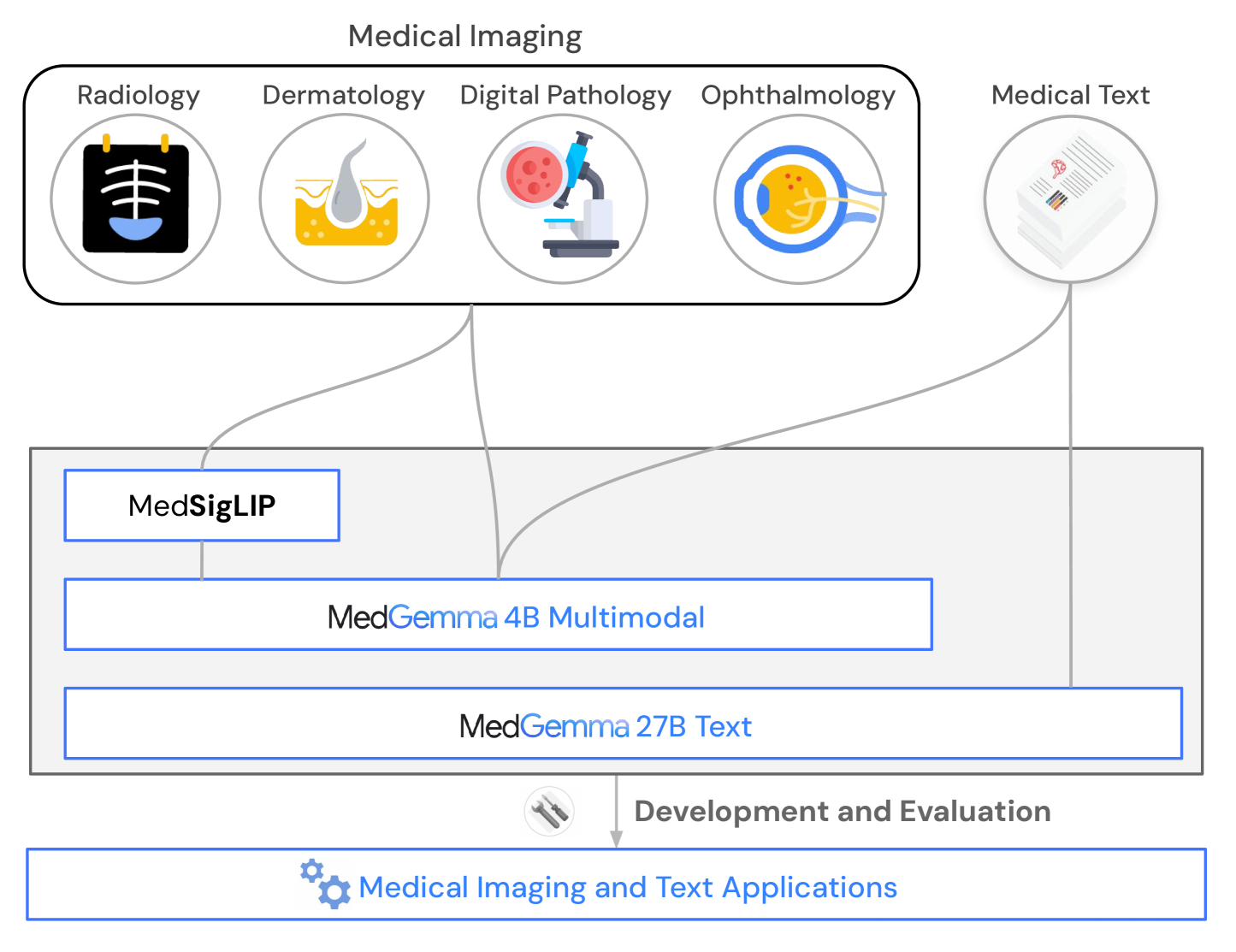
| Google Health AI — MedGemma | Open | MedGemma 27B / 4B (open weights) | 87.7% MedQA | On-prem via vLLM | Google 2025 |
| DrKhan.ai | Free patient | GPT-4 class per vendor claim | Comparable to GPT-4 | No data stored | DrKhan.ai 2026 |
| Doctronic | Patient + video | Custom ensemble + clinician wrap | 25.5M consults | Cloud, lifelong record | Doctronic 2026 |
The Foundation Models Underneath: Med-Gemini, Med-PaLM 2, MedGemma
Every wrapped medical AI product is built on a foundation model, and the choice of foundation model sets the ceiling on accuracy, the floor on hallucination rate, and the rules for deployment. As of August 2026 four models dominate the medical-AI conversation: Google's Med-Gemini (closed, 91.1% on MedQA), Google's Med-PaLM 2 (closed, 86.5%), Google's MedGemma (open weights, 87.7% on the 27B variant), and the general-purpose GPT-5.6 plus Claude Opus 5 (both used by Premedice in a dual-model ensemble).
Med-Gemini is the accuracy king on paper. It runs only on Vertex AI, which means every inference sends data to Google Cloud — disqualifying for European GDPR-pure deployments. Med-PaLM 2 and MedLM are accessible through enterprise Google Cloud contracts and inherit the same data-residency constraint. MedGemma is the open-weights outlier: hospitals can run the 27B text model or the multimodal variants on their own vLLM cluster, which keeps patient data inside the firewall and cuts per-token cost by 80-95% versus API pricing. The dual-model ensemble pattern Premedice ships — Gemini for retrieval-grounded answers, Claude for safety reasoning — sits on top of general-purpose models and accepts a small accuracy hit in exchange for a 3.8x hallucination reduction.
Training Data: What These Models Have Actually Read
Foundation models are trained on web-scale text — including PubMed, clinical guidelines, de-identified patient forums, and a long tail of low-quality health content. MedGemma's 27B variant was fine-tuned on a curated set of medical QA, radiology reports, and histopathology captions. Med-PaLM 2 was fine-tuned on MedQA, USMLE-style questions, and clinician-graded long-form answers. The general-purpose models Premedice uses are not medical-specific but were trained on enough medical text to score above 80% on MedQA without explicit fine-tuning.
Two consequences matter. First, no production medical AI is trained only on peer-reviewed literature — they all read forums, social media, and patient testimonials, which is why every credible product publishes a 'supports, not replaces' disclaimer. Second, training data drift is the leading cause of accuracy regression in production; MedGemma's 1.5 release explicitly addressed 3D volumetric imaging for CT and MRI because earlier versions degraded on those tasks. The honest answer to 'what has this model read?' is always a subset of the internet plus a curated medical corpus, and the only way to verify is to ask the vendor and read the model card.
Clinical Outcomes: Where the Evidence Is Strong and Where It Isn't
Randomized controlled trials of medical AI in real clinical workflows are still rare. The strongest evidence comes from three categories. First, MedQA and USMLE-style benchmarks, where Med-Gemini at 91.1% and Med-PaLM 2 at 86.5% are the published leaders. Second, clinician-blinded comparison studies — for example, Med-PaLM 2 won physician preference on 8 of 9 clinical axes when its answers were compared head-to-head with those of US physicians. Third, prospective deployments — for example, Medwise's NHS evaluation shows 92% accuracy on NICE-aligned clinical queries, and Google's TB-screening partnership with Apollo Radiology International aims at 3 million free AI screenings over the next decade.
The weak-evidence categories are real-world triage outcomes and long-term patient outcomes. Few products publish a randomized trial showing their AI triage reduced unnecessary ER visits or shortened time-to-diagnosis. None publish five-year survival data. The honest reading: medical AI is now good enough to be deployed in clinician-support roles, not yet good enough to be the deciding voice in a real case.
Regulation in 2026: FDA, EU AI Act, and the Global Patchwork
Two regulatory frameworks dominate 2026. The FDA's draft guidance on adaptive AI in medical devices carves a sharp line between clinical decision support (regulated, requires pre-market review) and wellness software (unregulated, no pre-market review). Symptom checkers marketed as 'support, not diagnosis' land in the wellness bucket and ship without FDA review. Symptom checkers that claim to diagnose a condition are now regulated.
The EU AI Act classifies medical AI as 'high-risk' from August 2026 onward, which requires conformity assessments, post-market surveillance, and a documented risk-management system for every product sold in the EU. Premedice is built GDPR-native and EU-resident by default; Google Health AI's MedLM is gated to non-EU regions for some features; ChatGPT Health is rolling out outside the EEA, Switzerland, and the UK first. UK NHS products like Medwise have their own MHRA pathway. The practical effect is that US patients will see consumer medical AI ship fastest, EU patients will see slower rollouts, and the regulatory floor for any hospital deployment is now a documented risk file, not just a CE mark.
Choosing the Right Medical AI for Your Use Case
If you are a hospital or health system that needs data residency, run MedGemma on vLLM on-prem — that is the only architecture that keeps patient data off third-party servers while still scoring above 87% on MedQA. If you are a clinician who wants a turnkey workflow tool, Medwise (NHS), DRAI (US), or Premedice's clinical plan fit. If you are a medical student or trainee, Medical Student AI's citation-backed tutor is the cheapest serious option.
If you are a patient or family caregiver, Premedice or DrKhan are the only products that combine free access with no-signup and a documented privacy posture. If you are a developer or a clinic building a product, Premedice's API (`pm_live_*` keys, OpenAI-compatible, eight medical tools preloaded) is the only production-ready open API in the category. The honest answer to 'which is best?' is 'best for what, in which country, with which data posture?' — and the rest of this guide unpacks each axis in the spokes that follow.
What to Watch Through 2026 and Into 2027
Three trends will reshape the category in the next 12 months. First, the EU AI Act's high-risk conformity assessments go live in August 2026, which means any product sold in the EU without a risk-management file will be pulled from the market. Second, multi-modal medical AI — models that read notes, images, and lab PDFs in one prompt — will become the default rather than the exception; MedGemma 1.5 already leads here. Third, the cost of running an ensemble of medical models in production is dropping fast — Premedice's dual-model stack now serves for under $0.02 per 1K tokens, which is roughly what a single-model call cost two years ago.
The combination of regulatory pressure, multi-modal capability, and falling cost means 2027 will look very different from 2025. The right move now is to pick the tool that matches your data posture and clinical scope, then audit its training data and clinical-review pipeline every six months.
Ready to try Premedice?
Get instant, AI-powered explanations of your lab results and symptoms — powered by 300+ medical databases.
Continue Reading


Most Popular
Best AI Medical Models in 2026: MedQA Scores Compared
ResearchMedGemma: Open-Source Medical AI That Runs on Your Hardware
TechnologyMed-PaLM 2: 86.5% MedQA Score, Zero Doctors Using It (2026)
ResearchAI Symptom Checker Architecture: How Premedice Cuts Hallucinations 3.8x
TechnologyMedical AI Privacy: AES-256 + Zero-Knowledge Architecture
SecurityDr. Elena Rostova, MD, PhD
Dr. Rostova is a clinical informatics specialist with 14 years of research in machine-learning systems for diagnostic decision support at Stanford Medical Center.
Expert Takeaway
Medical AI in 2026 is good enough to draft clinical notes, summarize a chart, and triage clear-cut symptoms. It is not good enough to practice medicine autonomously. The optimal deployment in 2026 is a multi-model architecture: MedGemma on-prem for image and notes, MedLM or Premedice for patient-facing chat, and a clinician-in-the-loop for every decision that matters.
Browse by Topic
QFrequently Asked Questions
Q1What is the most accurate medical AI in 2026?
Google's Med-Gemini leads the published MedQA leaderboard at 91.1%. For wrapped products, Medwise reports 92% on UK NICE clinical queries and Premedice reports 84.6% on an internal MedQA replication. Benchmarks overstate real-world accuracy by 8-15 points.
Q2Is medical AI FDA approved?
No standalone consumer symptom checker is FDA-approved in 2026. Hospital clinical-decision-support products require FDA pre-market review. Wellness software that explicitly does not diagnose is unregulated. The FDA's 2026 draft guidance carves a sharp line between the two.
Q3Which medical AI is HIPAA compliant?
Every product listed in this guide that operates in the US is HIPAA-aligned. DrKhan and Premedice go further with zero-retention and RAM-only architecture. Verify the specific vendor's BAA before pasting anything sensitive.
Q4Can medical AI replace doctors?
No, and no credible product claims to. The right mental model is the calculator: it replaced arithmetic, not mathematicians. Medical AI replaces the parts of the visit that don't need a human — orientation, plain-English explanations, lab reads — and leaves the parts that do — physical exam, accountability, empathy — to the clinician.
Q5What is the best free medical AI in 2026?
Premedice and DrKhan both offer genuinely free tiers. Premedice adds lab PDF interpretation, dual-model grounding, and citation links; DrKhan emphasizes absolute anonymity with no signup. Pick based on feature depth vs anonymity.
Q6Is medical AI safe?
For triage, lab interpretation, and appointment preparation, yes — credible products publish 'supports, not replaces' disclaimers. For active emergencies, no — call your local emergency number directly. The EU AI Act's high-risk classification for medical AI takes full effect in August 2026, raising the safety bar across the EU.
Q7Where can I read peer-reviewed medical AI papers?
Start with npj Digital Medicine (Nature), JAMA Internal Medicine, BMJ Quality & Safety, the Lancet Digital Health, and NEJM AI. Google Scholar indexes all of them; the MedQA dataset has its own arXiv preprint with up-to-date leaderboards.
Verified References & Literature
Med-PaLM 2 — Towards Expert-Level Medical Question Answering
Google Research / arXiv, 2023
View SourceMedGemma — Open-weights Medical AI
Google Health AI Developer Foundations, 2025
Adaptive AI in Medical Devices — Draft Guidance
U.S. Food and Drug Administration, 2026
Regulation (EU) 2024/1689 — AI Act, High-Risk Annex III
European Union, 2024
Large Language Models in Medicine: A Systematic Review
Nature npj Digital Medicine, 2025
AMIE: Towards Conversational AI for Clinical Reasoning
Google DeepMind, 2024
Get a structured second read in seconds
Upload lab results, describe symptoms, or ask about a diagnosis — Premedice gives you medically-grounded answers backed by 30+ clinical databases.