Medical AI vs General AI: What's the Difference and Why It Matters
Summary & Key Takeaway
The line between medical-purpose-built AI and general-purpose AI is blurring. In 2023, Med-PaLM 2's 86.5% on MedQA was a landmark. By 2026, DeepSeek-R1 — a general-purpose reasoning model — scored 92.5% on the same benchmark, surpassing human examinee averages. On raw multiple-choice accuracy, generalist models now dominate. But on clinical safety, hallucination control, imaging, and deployment within hospital firewalls, specialized models retain critical advantages. This article breaks down the differences across training data, benchmarks, safety, deployment, and real-world performance. For a comprehensive overview of medical AI, see our complete guide to medical AI. For practical guidance on choosing an AI doctor, see our AI doctor guide.
?? Core Insights
- General-purpose AI models now outperform medical-specific models on MedQA (USMLE) benchmarks.
- Medical AI retains critical advantages in hallucination control, uncertainty expression, and safety guardrails.
- HealthBench (clinical judgment) shows a 23-point drop for general models vs their MedQA scores.
- Medical AI can be deployed on-premise; general AI requires API access.
- For diagnostic-grade work, specialized medical models with RAG grounding remain the standard.
- The future is multi-model stacks: general models for chat, specialized models for clinical tasks.
- Medical AI training data includes clinical guidelines, drug databases, and radiology reports.
- General AI training data is broad internet text, which includes medical misinformation.
Try it yourself — free
Experience the medical AI that powers this article. Ask questions, check symptoms, or analyze lab results.
Want to know what a tool does with a panel like yours? See how the lab interpreter reads a blood panel.
Related Lab Tests
The Core Difference: Training Data and Purpose
Medical AI models are specifically trained or fine-tuned on medical data: medical literature, clinical guidelines, peer-reviewed journals, drug databases, radiology reports, and pathology captions. They are fine-tuned on USMLE questions, clinical case reports, and patient-physician dialogues. Their objective is to maximize clinical accuracy and safety. For a complete overview of medical AI technology, see our complete guide to medical AI.
General-purpose AI models are trained on broad internet text, books, articles, code, forums, and social media. Medical is one of many domains. Their objective is general reasoning, knowledge, and language tasks.
Examples of medical AI: Med-Gemini (Google) at 91.1% MedQA, MedGemma 27B (Google) at 87.7%, Med-PaLM 2 (Google) at 86.5%. Examples of general AI: GPT-5 (OpenAI) at 96.3%, Gemini 3.1 Pro (Google) at 96.4%, Claude Opus 4.1 (Anthropic) at 93.6%. For practical guidance on choosing an AI doctor, see our AI doctor guide.
The Benchmark Gap: Where Medical AI Still Wins
MedQA shows general-purpose models dominating: o1 at 96.5%, Gemini 3.1 Pro at 96.4%, GPT-5 at 96.3%, o3 at 96.1%. Medical-specific models trail: Med-Gemini at 91.1%, MedGemma 27B at 87.7%, Med-PaLM 2 at 86.5%.
HealthBench, the clinical judgment test, tells a different story: GPT-5.2 scores 88.0%, Gemini 3.1 Pro scores 79.3%, Claude Opus 4.6 scores 77.0%, GPT-5 scores 73.0%. The critical insight: GPT-5 scores 96.3% on MedQA but only 73% on HealthBench — a 23-point drop.
The safety gap is where medical AI retains critical advantages: hallucination control (trained on verified medical data vs may hallucinate medical facts), uncertainty expression (explicitly trained to hedge vs may present false confidence), clinical context (understands medical terminology vs may misinterpret), and safety guardrails (purpose-built for medical safety vs general-purpose safety only).
Deployment: On-Premise vs API-Only
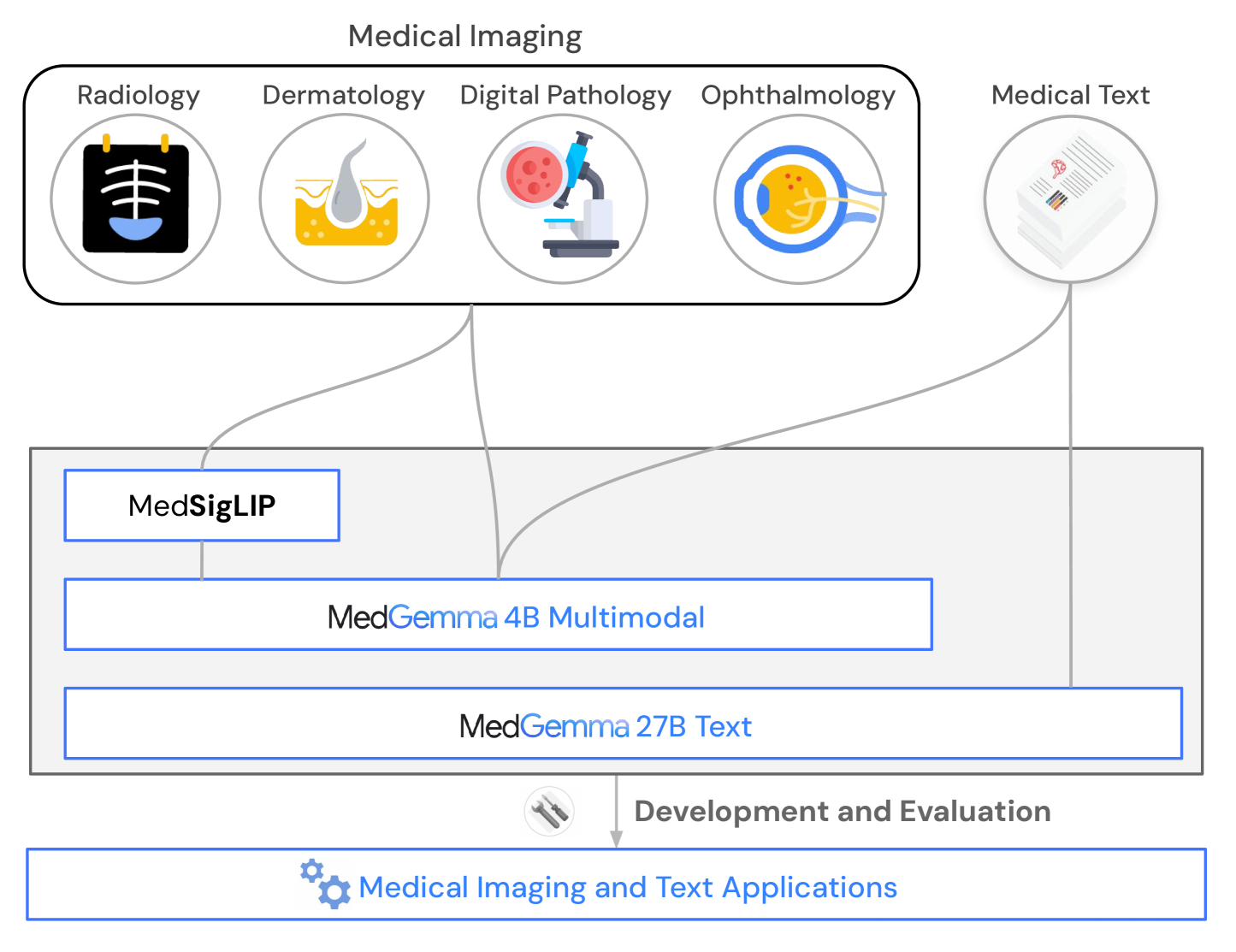
Medical AI models like MedGemma can run on-premise through vLLM, keeping patient data inside hospital firewalls. This is critical for HIPAA, GDPR, and hospital compliance policies. The cost is infrastructure-only (GPU time), roughly $0.50-1.50 per 1M tokens.
General AI models are API-only. Every inference sends data across third-party infrastructure. For a research institution that has cleared governance review, that is acceptable. For a hospital that must guarantee data residency, it is disqualifying.
The trade-off: on-premise deployment requires server-class GPUs (40GB+ VRAM for the 27B model) and technical expertise to operate. API access is simpler but introduces compliance risk.
Real-World Performance: Beyond Benchmarks
MedQA tests what a model knows. HealthBench tests what a model does with that knowledge in a conversation. This is where medical and non-medical models diverge most sharply.
General-purpose models excel at: broad medical knowledge, multiple-choice questions, and general reasoning. They struggle with: clinical safety (hedging, escalation), medical imaging (no native support), and hallucination control (may invent medical facts).
Medical-specific models excel at: clinical safety (purpose-built guardrails), imaging (native support for CT, MRI, pathology), on-premise deployment, and hallucination control (trained on verified medical data). They struggle with: broad knowledge (narrower training data) and general reasoning (less versatile).
The Future: Multi-Model Architecture
The trends converging in 2026 point to a multi-model stack rather than a single winner. Imaging-heavy workloads should route to self-hosted MedGemma for both capability and data-residency compliance. Text-heavy diagnostic reasoning benefits from specialized layers like MedLM, while generalist models handle conversational summarization. For a complete overview of medical AI technology, see our complete guide to medical AI.
RAG augmentation against live clinical guidelines should wrap every layer to close knowledge gaps and reduce hallucination. This is the architecture Premedice uses: dual-model ensemble (Gemini 3.7 Flash + Claude Opus 5) with RAG grounding against medical literature. For practical guidance on choosing an AI doctor, see our AI doctor guide.
The optimal deployment model is: general models for patient-facing chat (broad knowledge, natural language), specialized models for clinical tasks (safety, imaging, on-premise), and a clinician-in-the-loop for every decision that matters.
When to Choose Medical AI vs General AI
Choose medical AI when: you need on-premise deployment for data residency, you require native medical imaging support, clinical safety (hallucination control, uncertainty expression) is critical, or regulatory compliance demands purpose-built medical systems.
Choose general AI when: you need broad medical knowledge across many domains, you are building a patient-facing chat interface, cost is a primary concern (general models are cheaper), or you need rapid prototyping without medical-specific infrastructure.
The practical decision framework: for diagnostic-grade work, use specialized medical models with RAG grounding. For patient-facing chat, use general models with medical system prompts. For imaging, use MedGemma or similar medical-specific models.
Ready to try Premedice?
Get instant, AI-powered explanations of your lab results and symptoms — powered by 300+ medical databases.
Continue Reading

Most Popular
Best AI Medical Models in 2026: MedQA Scores Compared
ResearchMedGemma: Open-Source Medical AI That Runs on Your Hardware
TechnologyMed-PaLM 2: 86.5% MedQA Score, Zero Doctors Using It (2026)
ResearchAI Symptom Checker Architecture: How Premedice Cuts Hallucinations 3.8x
TechnologyMedical AI Privacy: AES-256 + Zero-Knowledge Architecture
SecurityDr. Elena Rostova, MD, PhD
Dr. Rostova is a clinical informatics specialist with 14 years of research in machine-learning systems for diagnostic decision support at Stanford Medical Center.
Expert Takeaway
General-purpose AI models now score higher on medical licensing exams than medical-specific models. But for clinical deployment — where hallucination control, uncertainty expression, imaging, and data residency matter — specialized medical models with RAG grounding remain the standard. The optimal architecture is a multi-model stack: general models for patient-facing chat, specialized models for clinical tasks.
Browse by Topic
QFrequently Asked Questions
Q1Is medical AI better than general AI for healthcare?
It depends on the task. General AI scores higher on medical licensing exams (MedQA), but medical AI retains critical advantages in clinical safety, hallucination control, imaging, and on-premise deployment. For diagnostic-grade work, specialized medical models with RAG grounding remain the standard.
Q2Why do general AI models score higher on MedQA?
General AI models are trained on broader data and have more parameters, giving them stronger reasoning capabilities. MedQA is a multiple-choice exam that tests knowledge, not clinical judgment. On HealthBench (clinical conversations), the gap narrows significantly.
Q3Can general AI replace medical AI?
Not for clinical deployment. General AI lacks purpose-built medical safety guardrails, native imaging support, and on-premise deployment options. For patient-facing chat, general AI is sufficient. For diagnostic-grade work, specialized medical models remain necessary.
Q4What is the best medical AI model in 2026?
For accuracy: Med-Gemini (91.1% MedQA). For open-source: MedGemma 27B (87.7%). For patient-facing apps: Premedice (84.6% internal benchmark). The best model depends on your deployment constraints and use case.
Q5Is medical AI safe?
For triage, lab interpretation, and appointment preparation, yes — credible products publish 'supports, not replaces' disclaimers. Medical AI models have purpose-built safety guardrails that general AI lacks. For active emergencies, no — call your local emergency number.
Q6How does medical AI handle hallucinations?
Medical AI models are specifically trained to hedge uncertainty and express when they don't know. RAG grounding against verified medical literature reduces hallucination. General AI models may present false confidence on medical topics.
Q7What is the future of medical AI?
The future is multi-model architecture: general models for patient-facing chat, specialized models for clinical tasks, and clinician-in-the-loop for every decision that matters. On-premise deployment and regulatory compliance will drive adoption.
Verified References & Literature
Med-Gemini: Achieving 91.1% on MedQA with Multimodal Medical Reasoning
Google Research / Nature Medicine, 2026
View SourceMedGemma vs Claude Fable 5: Open-Source and Proprietary Zero-shot Medical Disease Classification
arXiv (JMLDL), 2025
View SourceGet a structured second read in seconds
Upload lab results, describe symptoms, or ask about a diagnosis — Premedice gives you medically-grounded answers backed by 30+ clinical databases.