
Virtual Doctor Visit: AI Consultation Available 24/7
Summary & Key Takeaway
It's 2 AM and your child has a fever. You're not sure if it's an emergency or if you can wait until morning. Your doctor's office opens at 8 AM, but you need an answer now. Or maybe you just got home from work and realized you forgot to ask your doctor about that weird lab result. You want medical advice, but the only option available at 2 AM is the ER — which costs $1,500 and takes 6 hours for something that might be a simple question. A virtual doctor available 24/7 solves this problem: you describe your symptoms or ask your question, and get an evidence-based answer in under 60 seconds. No appointment. No wait. No signup. Premedice's AI doctor is always on.
?? Core Insights
- Virtual doctor visits via AI are available 24/7 with no appointment, no wait, and no signup required.
- AI virtual consultations work best for non-urgent health questions, symptom assessment, and lab result interpretation.
- For emergencies (chest pain, difficulty breathing, severe symptoms), always call 911 or go to the ER — AI is not a substitute for emergency care.
- Premedice's AI doctor uses dual-model architecture with PubMed, RxNorm, and OpenFDA grounding for evidence-backed answers.
- Virtual doctor visits cost $0 (Premedice free tier) vs $50-300 for telehealth video visits vs $1,500+ for ER visits.
Try it yourself — free
Experience the medical AI that powers this article. Ask questions, check symptoms, or analyze lab results.
Want to know what a tool does with a panel like yours? See how the lab interpreter reads a blood panel.
Related Lab Tests
What a Virtual Doctor Visit Actually Is
A virtual doctor visit is a medical consultation that happens remotely, without a physical examination. Traditional telehealth uses video calls with a human doctor. AI virtual visits use a large language model trained on medical literature to answer your health questions, assess your symptoms, and recommend next steps.
AI virtual visits are not telehealth. Telehealth connects you with a human doctor via video or phone. AI virtual visits use artificial intelligence to provide instant medical information. The distinction matters because the capabilities are different: a telehealth doctor can diagnose, prescribe, and order tests. An AI virtual visit can explain, assess, and recommend.
The value of AI virtual visits is speed and availability. You don't need an appointment, you don't need to wait on hold, and you don't need to explain your symptoms to a receptionist. You type your question, answer a few follow-up questions, and get an evidence-backed answer in under a minute.
The virtual doctor comparison explains the differences between AI virtual visits, telehealth, and traditional in-person consultations.
When to Use an AI Virtual Visit (and When Not To)
AI virtual visits are excellent for specific use cases and inappropriate for others. Understanding the boundaries keeps you safe.
Good use cases for AI virtual visits: Non-urgent health questions ('Is a ferritin of 15 dangerous?'), symptom assessment ('I've had a headache for 3 days — should I be worried?'), lab result interpretation ('What does eGFR 58 mean?'), medication questions ('Can I take ibuprofen with my blood pressure medication?'), and preparation for doctor visits ('What questions should I ask my doctor about my cholesterol?').
Bad use cases for AI virtual visits: Emergencies (chest pain, difficulty breathing, sudden severe symptoms), prescriptions (AI cannot prescribe medication), diagnosis (AI suggests possibilities but does not diagnose), physical examination (AI cannot examine you), and chronic disease management (AI supports but doesn't replace your doctor).
The key test: If you're asking 'Do I need to see a doctor?' the answer is probably yes. If you're asking 'What does this mean?' or 'Should I be worried?' — an AI virtual visit is a good first step.
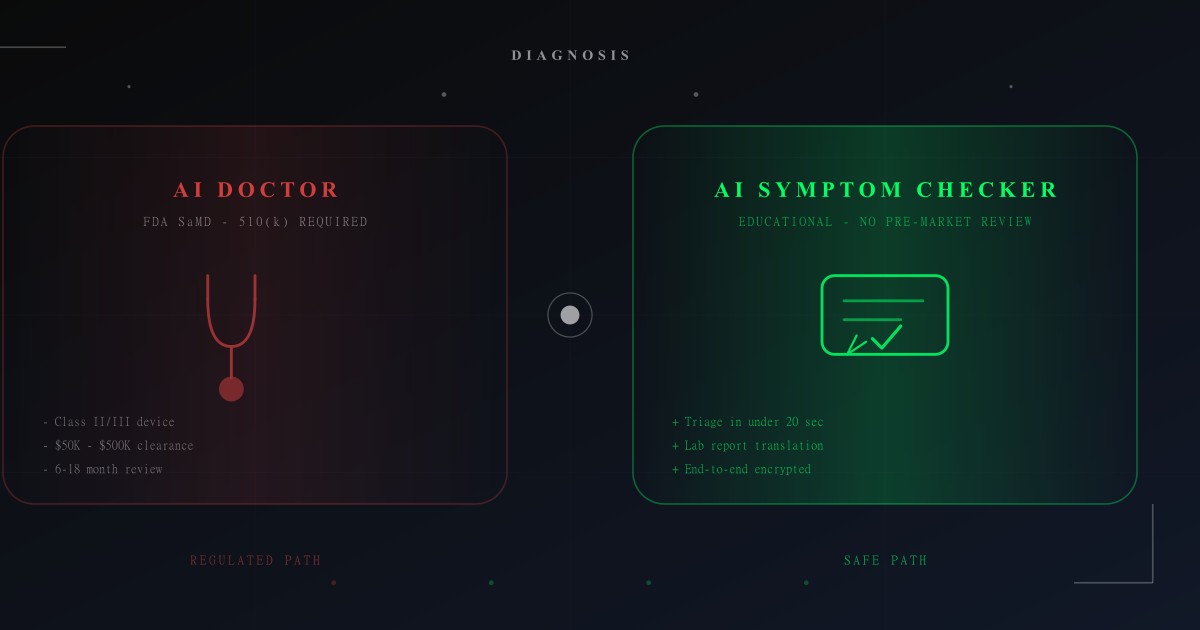
The AI doctor vs symptom checker regulation explains the legal boundaries of AI medical consultations.
How Premedice's 24/7 AI Doctor Works
Premedice's AI doctor is built on two independent large language models — Gemini 3.7 Flash and Claude Opus 5 — that cross-validate findings to reduce hallucinations by 3.8x compared to single-model systems.
You open Premedice, type your question or describe your symptoms, and the AI begins a conversational consultation. It asks follow-up questions ('When did this start?', 'Does anything make it better or worse?', 'Are you taking any medications?') — the same questions a human doctor would ask during a clinical history.
The AI grounds its answers against live medical databases: PubMed for clinical evidence, RxNorm for medication data, OpenFDA for drug safety, DailyMed for prescribing information, and ClinicalTrials.gov for treatment options. Every claim in the answer cites its source.
The result is an evidence-backed answer with specific next steps: 'Your symptoms are consistent with tension headache. Try ibuprofen 400mg, rest in a dark room, and apply ice to your neck. See a doctor if the headache persists more than 5 days or is accompanied by fever, vision changes, or confusion.'
The medical AI prompt that gets better answers explains how to phrase your questions for the most useful responses.
Virtual Doctor Visit Costs: AI vs Telehealth vs ER
The cost comparison between virtual doctor options is dramatic and directly impacts which option you should choose.
AI virtual visit (Premedice): $0 for the free tier, $5.99/month for Pro. Available 24/7, instant response, no appointment needed.
Telehealth video visit (Teladoc, Amwell, PlushCare): $50-300 per visit, depending on insurance and provider. Requires appointment, typically available same-day or next-day.
Emergency room visit: $1,500-3,000 for a basic evaluation, before any tests or procedures. Average wait time 2-4 hours. Available 24/7.
Primary care office visit: $150-300 without insurance, $20-50 copay with insurance. Requires appointment, typically 1-3 weeks wait.
The math is clear: for non-urgent health questions, an AI virtual visit provides immediate answers at zero cost. For situations that require a prescription or physical examination, a telehealth visit is the next step up. For emergencies, the ER is the only option.
How to Get the Most From Your AI Virtual Visit
The quality of your AI virtual visit depends on how well you communicate your situation. Here are five tips.
Be specific about your symptoms. 'My stomach hurts' gives the AI less to work with than 'I've had a burning pain in my upper abdomen for 2 hours, worse after eating, with occasional nausea.' The more detail you provide, the more accurate the assessment.
Include your medical history. If you have existing conditions (diabetes, hypertension, asthma), mention them. The AI uses this context to tailor its assessment.
List your current medications. Drug interactions are a common cause of symptoms, and the AI can check your medications against its database.
Ask follow-up questions. The first answer is rarely the complete answer. Ask 'What should I watch for?' or 'When should I see a doctor?' or 'Are there any home remedies that might help?'
Use the results to prepare for a real doctor visit. If the AI suggests you should see a doctor, write down the AI's assessment and bring it to your appointment. This makes your visit more productive.
Ready to try Premedice?
Get instant, AI-powered explanations of your lab results and symptoms — powered by 300+ medical databases.
Continue Reading


Most Popular
Best AI Medical Models in 2026: MedQA Scores Compared
ResearchMedGemma: Open-Source Medical AI That Runs on Your Hardware
TechnologyMed-PaLM 2: 86.5% MedQA Score, Zero Doctors Using It (2026)
ResearchAI Symptom Checker Architecture: How Premedice Cuts Hallucinations 3.8x
TechnologyMedical AI Privacy: AES-256 + Zero-Knowledge Architecture
SecurityDr. Elena Rostova, MD, PhD
Dr. Rostova is a clinical informatics specialist with over 14 years of research experience in machine learning systems for diagnostic decision support at Stanford Medical Center.
Expert Takeaway
AI virtual doctor visits are the fastest-growing segment of digital health. They fill the gap between 'I have a question' and 'I can see my doctor' — which for most people is 2-14 days. For non-urgent questions, an AI consultation provides evidence-based answers in seconds rather than days.
Browse by Topic
QFrequently Asked Questions
Q1Can I see a doctor online at 2 AM?
Yes. Premedice's AI doctor is available 24/7 with no appointment required. Type your question or describe your symptoms and get an evidence-based answer in under 60 seconds.
Q2Is a virtual doctor visit as good as an in-person visit?
Virtual doctor visits (both AI and telehealth) are excellent for non-urgent health questions, symptom assessment, and lab interpretation. They cannot replace in-person visits for physical examinations, emergencies, or conditions requiring hands-on care.
Q3Can an AI virtual doctor prescribe medication?
No. AI virtual doctors can recommend over-the-counter treatments and suggest you speak with a doctor about prescriptions. Only a licensed physician can prescribe medication.
Q4How much does a virtual doctor visit cost?
Premedice's AI virtual visit is free (no signup required). Telehealth video visits cost $50-300. ER visits cost $1,500+.
Q5When should I go to the ER instead of using a virtual doctor?
If you have chest pain, difficulty breathing, sudden severe headache, uncontrolled bleeding, or any symptom that feels like a medical emergency, call 911 or go to the ER. AI virtual visits are for non-urgent questions only.
Verified References & Literature
Get a structured second read in seconds
Upload lab results, describe symptoms, or ask about a diagnosis — Premedice gives you medically-grounded answers backed by 30+ clinical databases.